Monday, May 7, 2012

Book Review: Micro

(Warning: The following is filled with spoilers.)

I have a long history with Michael Crichton. When I was in second grade, I read Jurassic Park and loved it (though the film still terrified me a year later).  He had a knack for taking unbelievable future tech and plopping it down in the here and now, and somehow it turned out believable. In great part this was due to his research and attention to detail, and to his memorable characters. Ian Malcom, for example, one of the doomed protagonists of Jurassic Park, was brought back to life for The Lost World despite dying mid exposition in the original. And, ultimately, the villains seldom turned out to be truly evil. They were more often victims of greed or folly. John Hammond, for example, was a doting grandfather and otherwise generally benign eccentric who stood a little high on the shoulders of giants, and ended up falling hard for it (though his death was redacted in the film version). It's true that Crichton loved to write morality tales about human folly, whether that be in harnessing nature for profit (Next, Jurassic Park, The Lost World), technological fallibility (Timeline, Prey), the limits of human mental ability when faced with the unknown (Sphere, Congo), or simply pointing out our overall vulnerability as a species (Andromeda Strain). But since I came to expect morality tales as part and parcel of the Crichton enterprise, and since the novels were always so well written and well premised, the moral aspect was rendered almost mythical. Take Jurassic Park, again. The morality tale was that these humans expected they could control natural processes, that they would have the wisdom to make that step despite lacking total understanding. It's a modern retelling of Prometheus stealing fire from the gods. This simplified moral dilemma makes a better story. So, the moral aspect never really bothered me.

Well, I shouldn't say never. Among the many Crichton novels there was one stinker, State of Fear, the /only/ one I was unable to finish. It was overall a poorly researched work with one too many author avatars, a platform for Crichton's opinions on global climate change. I questioned his sanity after that one, though he did go on to write Next which was, if not as good as Timeline, at least was better than State of Fear. Fans of Crichton note a decline in quality near the end of his life, Next and Prey not nearly as memorable as Andromeda Strain and Congo.

When I heard recently that his last novel, part finished at the time of his death, had just been published with the help of Richard Preston, I decided to give it the benefit of the doubt. Richard Preston (not to be confused with his brother, Douglas Preston, also a great writer) is the author of The Hot Zone, a non-fiction collection of stories about the origins and discoveries of several different types of hemorrhagic fevers, including Ebola virus. So I knew that he could handle stories with a heavy scientific component, and was generally optimistic about this final Crichton novel, Micro.

Simply, the premise is a combination of harnessing nature for profit paired with technological fallibility, which brings to light human vulnerability in primal ways. A company based in Honolulu, Hawai'i, has developed high strength tensor magnetic field technology, which surprisingly has the ability to shrink living and non-living things down to microscopic size. This is the equivalent phlebotinum to Jurassic Park's cloning dinosaur DNA. You may be thinking "remake of Honey I Shrunk the Kids", but unlike that comedic plot device, the company starts shrinking down people to do micro-bioprospecting. Thus leading to a massive outpouring of new research, including basic natural history work all the way to medical applications. Of course, muckety muck, the CEO is a greedy sociopath, and along with all this great stuff the company is making micro-scale assassination drones (you knew it couldn't be that simple), and people are getting offed. There's also this pesky issue of people dying from "micro-bends" after spending too much time shrunk, with an ongoing investigation of people who "disappeared" into the micro world. Did I mention the protagonists are all biology graduate students, including entomologists? Did I mention, that the setting is O'ahu, mainly in the Manoa Valley and the slopes of Tantalus? I've been there, twice, and while species poor (it's fiction so tweaking the diversity is alright) is a great location. So, overall, the wild yet interesting premise of biology graduate students ending up trapped in the world of insects, in Hawai'i, with loads of insect natural history thrown in...that sounds like the set up to my favorite Crichton novel.

Unfortunately, what started with such a beautiful premise and could have had me gripped to a chair until I turned the last page, did not live up to my expectations. And the failure wasn't the premise but execution: one-dimensional characters that felt like cardboard, lengthy out-of place expositions (which sometimes had wrong information!), rushed writing, gory death scenes, one of those "boy gets the girl" stereotypical endings; in short, mediocre and disappointing.

Part of what makes the earlier Crichton books so believable is his ability to take these wild ideas and run with them, and at the same time get other basic details right. Cloning Velociraptor DNA from 65+ million year old amber trapped mosquitoes and inserting them into ostrich eggs may have been completely unbelievable, but it worked because he used the best information we had about dinosaur biology and ecology at the time. I was able to suspend disbelief because those creatures actually looked and acted like what I read by Robert Bakker and Jack Horner. And insects are that much easier to get right since they are still around, and there is copious literature about insect morphology, physiology, behavior, etc. Maybe it's just a pet peeve of mine, but when I'm trying to read a novel and the author gets one of the basics of insect physiology wrong not once but twice, and in ways important to the plot at the time, I start to cringe.

There were several instances of this, but the worst was the "breathing". For those of you not familiar, insects do not inhale and exhale as we do. They have a series of tubes called tracheae running from openings (spiracles) on the insect cuticle to deep inside the body cavity, narrowing as they go. Oxygen enters the air in these tubes by passive diffusion down gradient, and the cells pick this oxygen up at the narrowest parts (the tracheoles), which are filled with fluid. Carbon dioxide, the waste product of respiration, takes a different path; it passes out into the fluid filled cavity of the insect and dissolves in the hemolymph, the "blood" of the insect. Over time it dissipates out through the cuticle. As you can see, there's no breathing, no inhaling and exhaling, involved. Insects do ventilate at times, rapidly flexing and relaxing the abdomen, and there are a small number of insects that have discontinuous gas exchange, but never is this like vertebrate respiration. The basics of how insects respire is not some esoteric tidbit. It's often taught in undergrad biology 101 courses. So when either Crichton or Preston (whoever wrote these passages) get such a basic fact of insect physiology wrong, when they say the characters can hear the hissing of air entering and exiting the spiracles, slowing as the insect dies or increasing as it gets excited, I completely loose my suspension of disbelief. [This section is embarresingly off base. See http://www.sciencemag.org/content/299/5606/558 for work on insect active respiration. It's clear that probably most insects respire with aid of tracheole compression and dialation, at least in the head and thorax. This is what should be taught in schools, not passive diffusion. I've been served.]

The same is true of when characters, especially the protagonists, act like stereotypes and do it robotically. Take the introduction of our intrepid grad students. Our current main character, Peter (later a sacrificial lamb), walks around his lab talking to his fellow lab mates, asking them what they are doing. Now, of course, he supposedly knows what they are working on, being in the same lab with them day in and out, going to lab meetings, talking in free time, etc. Therefore, their answers should be just enough information to satisfy our curiosity about the characters, while at the same time not make Peter look like a completely unaware idiot. What we get instead is a lengthy exposition out of each of the lab mate's mouths, with copious jargon spoken in straight monotone, which is how all the later expositions sounded. Or at least I thought of it as monotone, because for most of the book the emotional status of each character feels like a poorly acted melodramatic soap. Heres an example from Peter's brother Eric (who didn't actually die at the beginning; spoilers!) after he finds out about Peter's death.

"Eric gasped as if he'd been punched. "No," he said. He closed his eyes. "No," he said again. he made a fist and slammed it on the dresser. "No!" He turned around and pounded the bed with both fists, and picked up a chair and threw it against the wall, and sand down on the bed and buried his face in his hands. "Peter...oh, Peter...God damn you Drake [ed.: the sociopathic CEO]...God damn you." [ellipses not mine]  --pg. 363

At other times, particularly following the gruesome, gory deaths of their lab mates at the hand of an arthropod, they seem to show no reaction at all. But it's a survival situation, you may exclaim, surely they should keep the hell going! Except, these aren't survival experts. These aren't Alan Grant and Ellie Sadler, who spent years in the badlands before heading into Jurassic Park. These are /grad students/ for goodness sakes! The most wildlands survival experience they've had is one of them once went to Puerto Rico on a trip , and another was a rape victim. I'm not trying to play down the horrors of rape, but it's hardly sufficient to prepare her for seeing an acquaintance torn in half by big headed ants the size of dogs.

Did I mention the gore? It's definitely overplayed in this one. I recall the death of John Hammond in Jurassic Park, who fell down the hill and got chomped by a herd of chicken sized dinosaurs. But the death and gore was carefully spliced out. You /knew/ he got eaten, but it was implied, not explicit. The amount of gore in Micro reminds me of the film Final Destination 5. My best friend and I decided it would be funny to watch, remembering the "spooky wind" stuff of the prequels. But we stopped halfway through because the goryness of the death scenes was completely unnecessary and over the top. It was frankly disgusting, which is about how I felt when one of the shrunk-down stooges out to get the protagonists gets "ebola-fied" by a spider. Preston used his experience to write it, I'm sure, and it was probably all correct, yet still completely unnecessary and a gigantic turn off.

I was going to expand on the stereotypes that each of the protagonists played up until their unfortunate demises, but I just realized that this is more typical of Crichton's mold. The difference is that Alan Grant made a believable conservative, workaholic paleontologist, while Danny (from Micro) was an unbelievable post-modernist, tweed wearing Haaaavard boy. The same with Rick the ethnobotanist environmentalist hippy. Strawmen abound.

Which brings me to the romantic element. Out of the blue, Rick (the environmentalist hippy) and Karen (the arachnologist rape victim) fall for each other in the midst of the carnage, and as the only survivors end up sitting on the beach together at the end like something out of a Clive Cussler novel. This nearly sappy ending didn't happen in any other Crichton novel I can remember (or maybe I remember poorly). Either Crichton has fallen a long way, or Preston really pushed the lowest common denominator. Even in Jurassic Park, where is was implied that Alan and Ellie were in a relationship throughout, there was no happy end scene. There was a epilogue scene at a hotel, following the escape from Isla Nublar, but it was played cool.

And then there's the villain, Vincent Drake, the sociopathic CEO who can't hide his greed. Yes, I know, I've called him that at least three times since the start of this review, but that is literally the total depth of his character. As soon as Peter gets an idea that his brother might have been murdered, Drake shrinks ALL the grad students down and tries to murder them all in succession, including one of his own employees. And then tries to murder them again. And a third time. This Dr. Evil will not negotiate. Which makes him completely unbelievable as a businessman and villain. Plus, part of the enjoyment in most Crichton villains is that they are at least partially sympathetic. When Drake died to his own micromachines it was more like putting down a rabies infected dog than a triumph.

The only two interesting characters in the book were the detective Dan Watanabe, and the microed employee who went native, Dan Rourke. But unfortunately only one of those had any airtime. The latter is killed off shortly after we meet him. Even Watanabe is a generously stereotyped Hawaiian, enjoying his spam sushi, using Hawaiian terms, but at least he doesn't feel like a cardboard cutout like the rest of the cast.

Overall, it took me two months to finish Micro, setting it down when I became disinterested and picking it back up again when I knew I had to finish, if only to return the book and write this review. And though the length was no shorter than Jurassic Park (421 versus 420 pages), the prose felt particularly rushed. It's almost as if Preston and The John Michael Crichton Trust were trying to get this out as quickly as possible. If that's the case, Micro suffered for it. I certainly suffered through it, despite my entomological inclinations. It's not clear who to blame for it, Crichton or Preston, since we have no indication how much was written at the time of Michael's death. The introduction was left unfinished. So I blame no one, or maybe just myself for setting my hopes too high.

Thursday, April 5, 2012

THIS is how you do a scratchpads site.

Behold the organized glory of Mosquito Taxonomic Inventory (MTI).

Scratchpads, if you aren't familiar with the platform, is a biodiversity networking tool created by ViBRANT, an EU funded project. The intent is to provide open-access, creative commons licensed software for a global community of taxonomists, natural historians, and other comparative biologists to draw together their knowledge in web-based format. As MTI shows, scratchpads can be an excellent tool, on level with the software behind AntWEB. This is clear with the preliminary information already hosted there.

I am quite impressed. But the reason I am impressed is sad. Until today I thought scratchpads was a flawed platform, a messy pooled slew of overwhelming, hard to navigate options that lead to either a sloppy mess or a webpage never updated. I admit, the majority of my exposure to this software has been through Fungus Gnats Online (FGO). Eventually my frustration with the search engine, poor organization and lack of control lead me to create Keroplatiwiki, I now have more control, but it is not nearly as slick as scratchpads can be if used properly.

Here is what makes MTI such a great example:

  • The front page is clean and clear: There are no unnecessary animations, no eye candy. In other words, it's not killing my eyes to look at the format. The header is a simple icon and the name of the network, all in those same cool, unobtrusive colors. Equally important is the content. The page explains not only what Mosquito Taxonomic Inventory is, but also exactly how to navigate the site's resources. Two small, clear photographs highlight the right side of the text, and that is all that is necessary. There is no extra clutter; the news tab and other messages are on a separate page.

  • Simple taxonomic navigation on the left bar: The left side has two expandable taxonomic hierarchies, and aside from a two sentence contact statement and a visitor map, that's it. One is for extant species, the other for fossils. The front page explains how to use these with relative ease. Above these is a search box, which is really not even necessary, a couple seconds faster retrieval of pages far down the hierarchy, if that.

  • Useful links (only!) on the right hand side: One of the things that absolutely drives me nuts about FGO are the huge number of categories listed in the sidebar. This is where my sense of organization and will to improve starts to go numb. Where do I even start? What's the difference between 'annotated bibliography' and 'biblio'? What is the 'character project'? What is 'page'? When are each of these necessary? How should I use them individually? Even clicking on the categories doesn't make that especially clear. And there's no indication on the home page, only a short blurb and 'recent' updates.
    MTI, on the other hand, has perfectly clear categories, all explained on the home page. There is a short hierarchy leading to individual morphology pages (e.g. head, thorax, and abdomen), links to individual parts of the Anatomical Glossary, the single, alphabetic by author bibliography, and four links to some general resources on classification and a list of valid names. No 'biblio', no 'page' and no clutter.

  • The individual pages are wiki-style: I know the claims of the scratchpads hub page. "Your data [images of different online databases, including Google] builds your site [!]" In theory this is a good idea. Why wouldn't you want to quickly gather as much information from as varied sources as possible and just insert it all, and voila! You have your complete network, ready to 'use'. In practice, it looks just about like what you would expect a hacked together site to look like, that is, a messy pile of useless crap. This is another one of those things that drives me nuts about FGO. The species pages are mostly populated by empty boxes, making them pretty much a copy of Encyclopedia of Life's relevant (or irrelevant, maybe) species pages. You can get the same information in the same format through Google, so why even have a network? The glory of MTI's chosen page format is that it filters down all the relevant information into a clear, written summary. If GBIF had a relevant piece of media, you could easily insert it later, but the initial choice of simplicity means that future clean up projects will not be necessary. More work initially, but more useful in the long run.

  • The Anatomical Glossary: I wanted to talk about this individually because it is absolute genius. The overview page explains the navigation of the glossary, but it is in about the clearest format I could want. Nine categories link to an alphabetic listing (by first letter) of all anatomical terms relevant to an individual life stage or structure type. Just as the rest of the site, the structure pages are wiki-style, with links to adjacent and similar anatomy, and a list of synonyms at the bottom. If every family of insects had one of these, we would be light years in distance ahead of the taxonomic problems we are now facing. This. Makes. Me. Giddy.

There is a lot of good quality information at MTI. One general flaw I can see is that, as of now, it is much more of a personal project than a network. But, please go check it out and compliment Ralph Harbach on his fine work. And if you are planning on making your own or are already hosting a scratchpads network, please shoot for this level of excellence!

Saturday, March 31, 2012

SFS 2012 Louisville, KY

Today was the last day for early registration to the 2012 Society for Freshwater Science (formerly NABS) annual meeting in Louisville, Kentucky, and I squeezed in mine just in time. Since I was forced to state an "University/Organization", and I no longer have any affiliations, I just put down "freelance taxonomist". Hope that works.

This year's focus is on freshwater stewardship on a global scale. If you are familiar with the former incarnation of SFS, the North American Benthological Association, you'll know this international focus is recent. And NABS was the creation of the older Midwestern Benthological Society, founded in 1953. Back then, the focus was mostly on provincial aquatic invertebrate biology and ecology, with a large taxonomic component. Over the past 20 years the focus has become more inclusive, with an unfortunate decline in taxonomic contributions.

Still, I am looking forward to attending. Some of my thesis work is being published in a key to the mayflies, stoneflies, and caddisflies (EPT) of the Southeastern United States, and my mentor is giving a talk about it. There's also the taxonomy fair, which I hope will be well attended, and hopefully some taxonomy related sessions and posters. And of course I'll attend the sessions on biomonitoring and behavior. There is no information on individual talks at the moment, so I will update on my "must see events" when I get more information.

Will any of my readers be attending? If so, I look forward to seeing you there!

Friday, March 30, 2012

"That's not Asindulum tenuipes, that's my wife!"

In Neal Evenhuis's Catalog of Keroplatidae of the World (PDF), he lists two described species of Asindulum as found in North America. This is a keroplatid genus of four described extant species, the other two in Europe and the Middle East, and four more fossil species found in Baltic amber. It's a distinctive genus among the mess which is the Orfellini, a tribe of closely related genera which are still being worked out. Both Asindulum and the sister genus Macrorrhyncha have long mouth parts, at least the length of the head. The only species studied in any detail, the Palearctic Asindulum nigrum, is known to feed from flowers of the parsley family (Apiaceae) (Betchev 2010).

Asindulum or Macrorhyncha feeding from a flower. Since the separation is based on wing venation, and this specimen has it's wings folded, I'm not sure which genus. If you know the flower, please tell me! (CC Tom Murray)

As I may have mentioned previously, I'm in the very beginnings of working out the North American Keroplatidae. All the Nearctic fungus gnat families are sorely in need of revision, but I have made this group my darling. The first step in any revision is pooling the literature, and determining the condition of all the type specimens. The types are individual or series of specimens which the names are supposed to refer. I say "supposed to", because type specimens are often found damaged, mislabeled, or not found at all. Often the descriptions in the literature are enough that the identity of the species is not in question, even without a type. Other times, the only description was the original one, and the type is not available. If the species was named more than 100 years ago, that description may be essentially useless, and the type must be found to clarify the meaning behind the name. Otherwise, it will become a nomen dubium, a "doubtful name" which, although available under The Code, may not refer to anything meaningful.

So, I am one by one figuring out the providence of the North American keroplatid types, including the two species of
Asindulum mentioned above. Asindulum montanum was described by the German dipterist Victor von Röder in 1887, and though the description is short and includes no useful illustrations, plenty of later taxonomists have identified members of this species. The male and female syntypes are housed in the Zoological Institute of Martin Luther University in Halle, Germany, and while I will still need to see them, I can at least rest assured they exist.

The other Nearctic species,
Asindulum tenuipes, was more of a mystery. It is only mentioned once in the keroplatid literature, and that is in the original type description. The species was described by Francis Walker in 1848, a worker notorious for his method of describing species, which can be summed up as "piss poor". And indeed, the description gives us only minimal information and no illustrations. It's not even clear where the type is housed, although much of Walker's collections are at the Natural History Museum in London.

The only clue is in the name of the person who collected the type, a "G. Barnston, Esq". Further searching revealed that George Barnston (see painting here) was an Scottish fur trader employed by the Hudson Bay Company in the early 1800s. During his 42 year tenure with HBC he also engaged in naturalist study, including entomology and botany. The type of
A. tenuipes, then, was undoubtedly collected during his time at St. Martin Falls on the Albany River, Ontario, from 1834-1840, since Walker lists this as the type location. In 1843-1844, Barnston took a year long furlough to England, and during this time donated his entire collection of insects to the British Museum (Brown and Van Kirk 2000). Despite Dr. Evenhuis listing the location of the type as unknown, I suspected it was still housed there.


An aerial photograph of the Albany River, Martin Falls, Ontario, the supposed type location of A. tenuipes. (Via the Martin Falls (Ogoki Post) community homepage)

I contacted Dr. Erica McAlister, the Diptera collections manager at the Natural History Museum in London (who, by the way, has an excellent blog). She was very helpful in my search. Yes, indeed, they have the type of A. tenuipes, and despite the giant pin nearly cleaving it's thorax in two, it's in pretty good condition. Also, would I like it imaged? (Oh, would I!)

Unfortunately, or maybe fortunately, imaging was unnecessary. Yes, this was the type labeled "Asindulum tenuipes". Yes, it was in good enough condition to photograph. Yes, it matches the type description. But this was
not a keroplatid of any kind. This was in fact a blepharicerid.
A net-winged midge (Blephariceridae) of the genus Agathon. Note: NOT a fungus gnat. (CC Tom Murray)

This was not unknown. That Walker had made a mistake was not noted at the time of Vernon Kellog's North American revision of the Blephariceridae (1903), but it was known by 3 years later (Riley 1908). Indeed, the Blepharicera tenuipes Group of species has been the recent subject of close study (Moulton 2007, Jacobson 2010). The type of Asindulum tenuipes is now referred to Blepharicera tenuipes. And somewhere in the transition this bit of information was lost in the fungus gnat literature. I was consoled by Nigel Wyatt, the Curator of Diptera, that this is a normal occurrence with Walker types. "I don't find it at all surprising that Walker could have mistaken a blepharicerid for a fungus gnat", he told me, "working here and often dealing with Walker's type material I have found this level of mistake is not unusual!"

This whole exercise is illustrative of the winding pitfall strewn road that is taxonomic research. A taxonomist might search days, months, years for a single specimen, and when at last she comes upon it tucked away in a museum drawer, she finds it is not at all what she was looking for in the first place.

The MOST IMPORTANT THING is, when this happens, write it down. Don't make some other researcher come along and spend vital time digging up such a tidbit. Publish it in print, on-line, somewhere. Natural history progresses by the accumulation of knowledge, and that only works if we add to and organize the pile.

Works Cited

Bechev, D. 2010. Flower visitation of fungus gnats from the genera Antlemon, Asindulum and Macrorrhyncha (Diptera: Keroplatidae): published data and a new record. ZooNotes 7: 1-3.
Brown, J. S. H., and S. M. Van Kirk. 2000. Barnston, George - Dictionary of Canadian Biography Online. University of Toronto. [WWW]http://www.biographi.ca/009004-119.01-e.php?&id_nbr=5360
Evenhuis, N. L. 2006. Catalog of the Keroplatidae of the world. Bishop Museum Bulletin in Entomology 13, Bishop Museum Press, Honolulu.
Jacobson, A. J. 2010. Phylogenetic analysis of the Nearctic Blepharicera Macquart (Diptera: Blephariceridae) with an emphasis on the eastern Blepharicera tenuipes Group Hogue. PhD Dissertation, University of Tennessee - Knoxville.
Moulton, J. K., and G. R. Curler. 2007. A new species of net-winged midge of the genus Blepharicera Macquart (Diptera: Blephariceridae) from the cumberland plateau of Tennessee. Proceedings of the Entomological Society of Washington 109: 920-929.
Riley, W. A. 1908. The divided eyes of Blepharocera tenuipes Walker. pp. 280-281 in Howard, L. G. (ed.). Proceedings of the American Association for the Advancement of Science Fifty-Sixth and Fifty-Seventh Meetings. Gibson Brothers, Washington, D.C.
Walker, F. 1848. List of the specimens of dipterous insects in the collection of the British Museum. Part I. British Museum, London.

Monday, March 19, 2012

Scientists-who-are-not-paid.

I absolutely love Nancy Collins's article in the new Spring issue of American Entomologist. She's a perfect example of a passionate naturalist, a taxonomic specialist of Ocanthinae (tree crickets). She has traveled the continent (and beyond), collecting, recording songs, and identifying specimens. Her website is excellent, with a level of detail and public outreach to serve as models for the rest of us. She is a scientist.

But I don't see why I need to talk about her as a "citizen scientist". She has published original research, worked in connection with other researchers, presented at professional meetings, and is an expert in her group. She's an autodidact, sure, but so is every other taxonomist; specialist taxonomy isn't exactly taught in classes. There's no "Orthoptera 101" course taught at university. I for one don't think there is a need for a disclaimer at the bottom of her website, saying her research "has no scientific basis".

Is there something I'm missing here, some sort of requirement that scientists must get paid to do scientific work in order to be (flat out) scientists? Am I the only one who thinks oxymoron when the phrase "professional amateur" appears in print?

I'm not knocking the intentions of the American Entomologist editors. This issue's focus on "citizen science" was a product of a special session from last year's annual meeting. It was meant to spotlight entomological research going on outside of academia, which is good and right and noble. And I know they didn't mean anything insulting by it.

But when people of any age do good scientific research, paid or unpaid, within or outside of academia they are not "citizen-scientists" or "para-taxonomists", they are just scientists and taxonomists. They are certainly not "amateurs", as their knowledge attests to work equaling "professionals". I can't be the only one who finds this condescension like head patting when a child scores high on an exam. I value Nancy's research higher than that. We don't need to qualify it as somehow different.

Or if you must, 'taxahacker' is acceptable. Though, some people may find that offensive for other reasons.

Sunday, March 4, 2012

YAGS, and why it is good for natural history.

I recently came across the term YAGS (Yet Another Genome Syndrome) in reference to the iceman genome sequence. I originally empathized with the sentiment, that genome sequencing has been done, and that the hype over new genome sequences is unfounded. But I have since revised my position.

Ultimately, YAGS is a sign that people are bored with genome sequencing, that it is no longer SHINY and new use of technology. It has become 'cataloging'.

This excites me.

If genome sequences have become a "mundane" descriptive enterprise rather than an experimental use of technology, it has become ideographic science. It has become natural history. Genome description, then, continues as an exercise on par with morphological description, something with which all taxonomists are familiar. With soon to be 4th generation nanopore sequencing, I could in a few hours have the sequence to any of those insects which have been ignored by geneticists. I could have a sequence, for around 900 USD, of any caddisfly I wanted. What has become boring for the futurists is exciting new ground for naturalists. Because it is when a large mass of genomes are assembled, when these individual papers build on each other, then patterns will become evident.

Another tool in the toolbox, nearly ours for the taking.

Sunday, February 26, 2012

The fly with the feathery antennae.

In 2009, my mentor was part of an ecosystem survey project at Lago Copa, a recently created national park in Chile. He was using Townes traps to collect adult caddisflies, but he also kept representatives from other groups, including Diptera. When he returned I volunteered to sort out the caddisflies (these were alcohol-preserved samples he hand picked in the field), and I also sorted out any fungus gnats I found. The gestalt for many fungus gnats is easy enough to pick them out around other flies, even without magnification. They tend to have long antennae, long coxae and legs, multiple tibial spurs, a thin, curving abdomen that widens towards the tip, and often have patterned wings. They also tend to be laterally flattened, which sets them off from the boxy muscoid flies. In particular, I was looking for members of the family Keroplatidae, some of which have stout, flattened antennae as well as the above characters. If I had to describe the over all shape in simple terms, they look like two arches joined by three pillars, with wings outstretched behind.

Imagine my surprise when I found this critter among the mix.

The mystery fly, semi-left habitus. CHILE: PROVINCIA AYSEN: Municipalidad Cisnes, Parque Nacional Lago Copa, S. side of E. Lago Copa, unnamed 1st order stream, from cascade 200 m E. of Cliffs Lodge, S44.89155, W072.62070, 15-18.xii.2009.

If this was a fungus gnat, it was the strangest individual I had ever seen. First of all, the antennae are pectinate (feather-like), and there are few Diptera which have this character. This wouldn't eliminate Sciaroidea from the search, since there are genera in Ditomyiidae, Mycetophilidae, and Keroplatidae with species bearing pectinate antennae (Matile 1981). But then there are the other unusual characters.


The hindlegs are like nothing I had seen before. The tibiae are bowed and pressed forward in a grove against the femurs, so the tarsi lay close to the coxae. They resembled those of chalcid parasitoid wasps, which use those strong hind legs to capture prey for their young. The abdomen is short and conic. And the wings confuse the rest.


The wing veination looks as if it could have come from a fungus gnat, but the thick apical stigma and just how strong the veins are, how dark and heavy, reminds me more of a wasp wing. The halters mean it is obviously a true fly, but it looks like someone has glued on parts from other insect orders. I sent some pictures to Sciaroidea experts but the identity of this chimera continued to be a mystery.

I finally sent the above photos to Dalton de Souza Amorim, a South American fly expert, and he replied with a diagnosis he was nearly 100% sure of. But this was not a fungus gnat. It wasn't even in the Sciaroidea superfamily. This was a Canthyloscelidae.


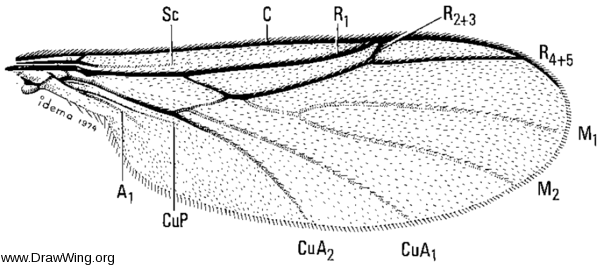
Wing of male Exiliscelis californiensis from the Synneuridae chapter of Manual of Nearctic Diptera. (Via DrawWing) If I didn't know better, I would say this came from a keroplatid.
The family Canthyloscelidae is a small family of flies in the "lower" Diptera, with ~15 extant species in 4 genera, found native in all faunal regions except the East Palearctic and Afrotropics. There is disagreement as to whether it should be placed with the Bibiomorpha or Psychodomorpha; larval structures suggest the latter (Amorim 2008) while adult characters alone suggest the former. Canthyloscelidae used to be split into two or more families, the Synneuridae and Canthyloscelidae (sometimes previously combined under Hyperoscelidae (Hutson 1977)), but these were joined by the time of Haenii's canthyloscelid chapter in Contributions to a Manual of Palearctic Diptera (1997).

This particular species is Canthyloscelis pectinata, the only species in this family with the males bearing strongly pectinate antennae. It has been recorded from Argentina and Chile in very low numbers (Hutson 1977), which means this may be one of less than 20 specimens ever collected, a rare find (Amorim pers. com.).


Exiscelis californiensis gathering on Potentilla flowers, Lowder Mountain, Oregon. (© 2011 Jake Hurlbert)

In North America, there are two species of Canthyloscelidae in two genera, Synneuron decepiens and Exiscelis californiensis. S. decepiens is found at Northern latitudes across the continent, while E. californiensis is only found on the Northwest Coast. Both are found in "ancient forests" (Triplehorn and Johnson 2004). Very little is known about their biology; larvae live in decaying wood "permeated by [fungal] mycelia" (Peterson and Cook 1981), and this family's close relationship with Scatopsidae suggests they feed on the fungi and microorganisms associated with such habitats.

In all, it was a nice little treasure hunt. I think taking time to jump outside my comfort zone and identify something so strange to my experience is an excellent exercise. It improves my skill as a taxonomist and teaches me about groups beyond my research. But most of all, identifying something weird is /fun/. Finding something strange and new, even if it's just new to you, is one of the greatest pleasures of natural history research.


References
Haenni, J.-P. 1997. Family Canthyloscelidae. In Papp L. & Darvas B. (eds): Contributions to a Manual of Palaearctic Diptera. Nematocera and Lower Brachycera.. Vol. 2. Budapest: Science Herald. pp. 273–279.

Hutson, A. M. 1977. A revision of the families Synneuridae and Canthyloscelidae (Diptera). Bulletin of the British Museum (Natural History) Entomology 35(3):67-100.

Johnson, N. F., and C. A. Triplehorn. 2004. Borror and Delong's Introduction to the Study of Insects, 7th ed. Brooks Cole, St. Paul, MN.

Matile, L. 1981. A new Austrailian genus of Keroplatidae with pectinate antennae (Diptera: Mycetophiloidea). Journal of the Austrailian Entomological Society 20: 207-212.

Peterson, B. V., and E. F. Cook. 1981. Chapter 21. Synneuridae. Manual of Nearctic Diptera 1: 321-324.