Friday, January 20, 2012

An Addendum to 'Misconceptions About Taxonomy'.


Original post is here.

I have been reading Steven Jay Gould's Wonderful Life: The Burgess Shale and the Nature of History. The work in entirety is a controversial illustration of a quiet yet revolutionary change in biology, which was later disputed by the researchers who made the discoveries. A section from page 80 is most relevant to my post, where Gould discusses how the romanticism of field work and the "technocratic myths about machine-based novelty" have very little to do with the new discovery of disparity of forms in the Burgess Shale.

The myth of field work, for example, proclaims that the great alteration in ideas arise from new, pristine discoveries. At the end of the trail, after weeks of blood, sweat, toil and tears, the intrepid scientist splits a rock from the most inaccessible place on the map, and cries Eureka! as he spies the fossil that will shake the world. Since the Burgess [ed.: taxonomic] revision was preceded by two full seasons of field work, in 1966 and 1967, most people assume that discoveries of this expedition prompted the reinterpretation. Well, [Harry] Whittington and company did find some wonderful specimens, and a few new species, but old [Charles] Walcott, a maniacal collector, had been there first, and had worked for five full seasons. He therefore got most of the goodies. The expeditions[...] did spur Whittington into action, but the greatest discoveries were made in museum drawers in Washington [at the Smithsonian]-- by restudying Walcott's well-trimmed specimens. The greatest bit of "field work", as we shall see, occurred in Washington during the spring of 1973, when Whittington's brilliant and eclectic student Simon Conway Morris made a systematic search through all the drawers of Walcott's specimens, consciously looking for oddities because he had grasped the germ of the key insight about Burgess disparity.
...
The Burgess revision did require a definite set of highly specialized methods, but the tools of this particular technology do not extend beyond ordinary light microscopes, cameras, and dental drills. Walcott missed some crucial observations because he didn't use these methods--but he could have employed all Whittington's techniques, had he ever found the time to ponder, and to recognize their importance. Everything that Whittington did to see farther and better could have been done in Walcott's day.
For the most part, taxonomy does not employ any fancy new methods. In fossils, the methods are much the same as they were 100 years ago. In insects, this is similar; we have devised some new tools to find characters in molecules, but the old visual microscope and hand drawing methods are tried and true. Most universities with a physics department have had a scanning electron microscope since the 1970s, and many biology departments have their own.

Likewise, most taxonomic work, be it on fossils, insects, soil invertebrates, or ocean plankton, does not take place in the field. Most collecting is in bulk samples, which are later sorted through, and all the items of interest are taken out by the investigator. The rest of the sample (if not tossed) is stored for future research. For example, the Field Museum of Natural History in Chicago, IL, has an extensive alcohol-stored collection of insect bulk samples from around the world. Over decades these are picked through, and discoveries are made. In addition, all museums have orphaned specimens, or specimens the collector thought were interesting but didn't have enough time to investigate. Given the diversity of life in insects, it is not surprising that any single researcher, specializing in a particular group, will overlook new species or genera in his or her picking. Just like the Burgess Shale fossils, many future discoveries are already waiting on a museum shelf.

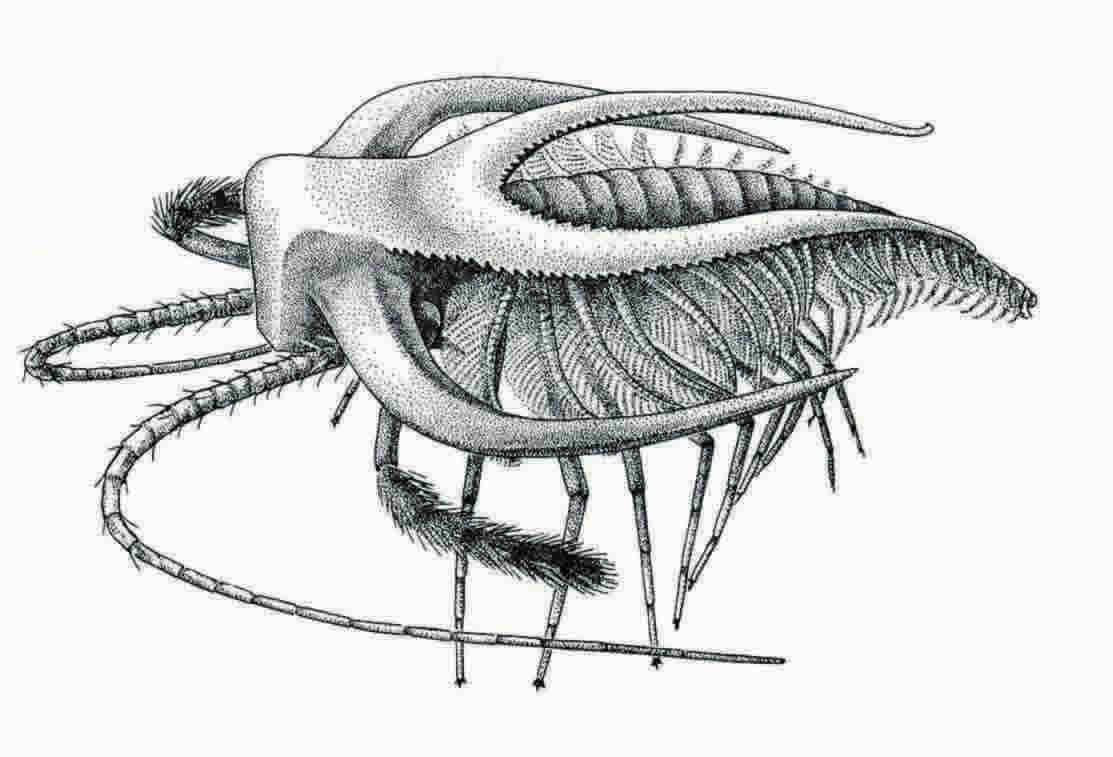
Drawing is a reconstruction of Marella, the most common Burgess Shale arthropod fossil. © Marianne Collins, from Gould's Wonderful Life (1989).

Tuesday, January 3, 2012

The hollow curve, lumpers versus splitters, and arbitrary (yet useful) ranks.

Yesterday, science journalist Ed Yong asked "which genus has the largest number of living species" as a Google+ thread. He admitted that it was a trivial question of curiosity, and he's right. While the wood boring genus Agrilus (Coleoptera: Buprestidae) may have the most described number of species (~3000), this is not a particularly important or interesting question when it comes to taxonomy or systematics in general. However, the question spawned an energetic argument over the arbitrariness of taxonomic groups in terms of size and content, and I wanted to speak my piece about it.

[If you graph] the number of genera contained in any group [of organisms] against the number of species contained in those genera, using one axis for genera and the other for species, we get, apparently regardless of the group we are dealing and the quality of the systematic work done upon the group, a curve of a characteristic form. This has been called the "hollow curve of distribution". (from Ferris (1928) The Principles of Systematic Entomology)

In modern ecology the hollow curve describes the relative species abundance within a community, but it also describes the distribution of species within genera. A small number of genera will have a large number of species relative to the whole, and a greater number of genera will each have a relatively small number of species. Unlike ecology, this was an probably an artifact of human taxonomy and the continuous disagreement between "lumpers" and "splitters".
An exaggerated "hollow curve of distribution" for visualization, with numbers of species on the Y axis and number of genera on the X axis.

The general consensus in systematics is that species are real groups of organisms, and for the purposes of this post I would not like to argue over that point, or about genetics or species concepts. Likewise, monophyletic groups, that is, groups of species which share a single common ancestor, are also real. After the modern evolutionary synthesis and the description of classification as the depiction of evolutionary relationships and not overall similarity (regardless of relationship), monophyletic groups became the standard for describing taxa.

A simplified version of the Linnean Hierarchy (© Tutor-Vista)


However, taxonomic ranks (e.g. family, genus, tribe) above species and the decision to place a particular group as a genus or a tribe, for example, is completely subjective and somewhat arbitrary. The hollow curve of distribution was due to the choice of some taxonomists to make large genera ("lumpers"), and of others to whittle those large genera down to smaller genera over time, or to raise a genus to tribe and the subgenera within to genera ("splitters"). This is sometimes called "taxonomic inflation" by those who see this tactic as an attempt by the taxonomist to raise the public importance of his or her group of interest. These split up genera are all monophyletic groups, just much smaller, more manageable monophyletic groups. (ETA: other hypotheses in the comments)

Still, the Linnean ranking system remains useful in relating hierarchy. It is unambiguous that a tribe belongs to a family, that a subgenus belongs to a genus (ETA: though not necessarily to the genus you /think/ it belongs to, or including the members you would expect: see comment by Christopher Taylor below). If I tell you a species is of the Tribe Hydropsychini, it is taken for granted that the tribe contains genera, and is contained by a family (in this case Hydropsychidae). This makes it easy to organize the general reference system. Ranks also make it easier for taxonomist to communicate their phylogenies. (ETA: Again, see comment by Taylor below)

Unfortunately there are some taxonomists who are uncomfortable with the Linnean system of ranks. Among these are the people responsible for the Phylocode. The Phylocode eliminates the Linnean ranking system and replaces it with a hierarchy of unranked "clades", while species names are still described under the rules of the already established codes of nomenclature. This to me seems like hierarchical obfuscation. While it is very easy to communicate a hierarchy using ranks, it is very difficult to do so without them. Anti-ranking advocates complain there are not enough ranks to properly describe all the monophyletic groups, but the code doesn't prohibit the creation of new ranks above and within family level ranks, they just are not covered under the rules. If you want to talk about a semi-infra-tribe, or a super-kingdom, that's perfectly acceptable. Any other criticisms, like the issue of hybridism, are best addressed within the individual codes. To collapse and remake the entire general reference system just to eliminate rankings (which are useful in their own right) is preposterous. Enough people were upset over the Drosophila case that there may be rioting in the universities if Phylocode is ever successful.

So, while the arguments that taxonomic groupings are arbitrary is false, ranks are somewhat arbitrary and yet useful. The important notion is to not rely on them as indicators of importance. And that questions like "what's the largest genus" comes down to a trivial contest of lumpers versus splitters. In this case the winners are probably beetles (is anyone surprised?).
Agrilus derasofaciatus (CC Encyclopedia of Life)

Monday, December 19, 2011

The story behind "Azana sinusa: remarks on range and records."

I previously promised to blog every one of my future publications. And finally, I am able to follow through on the first one. I'll be using Eisen's brilliant blog post about the "Stalking the 4th Domain" paper as a format guideline, but since this is very much a small scale natural history story rather than a large scale molecular biology story, I'm mostly making this up as I go. As a natural history story, it may not seem like science to all people. Taxonomist FPD Cotterill calls natural history an ideographic science, a science of details that provides the primary support for the wide scale theorems of law-like or nomothetic science. And as such, denigration of natural history does not fair well for biology in general. So I will pass by the naysayers and move forward.


Burington, ZL. 2011. Azana sinusa Coher, 1995 (Diptera: Mycetophilidae: Sciophilinae): remarks on range extension and collection records. Check List 7(6):815-816. PDF


The Backstory

In late 2010 I was attempting to organize the wet-stored specimens of Sciaroidea (fungus gnats) in the Clemson University Arthropod Collection. The CUAC does not have a very large collection of the group, only 100 to 200 specimens, most of them collected before 1990 by former students or in flight intercept traps. Fungus gnats are of great interest to me, since they are greatly understudied in North America, with perhaps less than 50% of all species described. In particular, I'm interested in the Family Keroplatidae, the predacious or web-spinning fungus gnats, the larvae of which spin a web of sticky silk to capture small arthropods or fungal spores. You may have heard of the cave glowworms of New Zealand, a popular ecotourist destination; these bioluminecent fungus gnat larvae are keroplatids.

I was using the genus key in the Manual of Nearctic Diptera (MND) (now available for free online) to identify the adults. Despite being thirty years old and somewhat out of date, the MND worked well enough for my purposes. When I identified specimens from two different vials as the genus Azana, Family Mycetophilidae, I was intrigued. The specimens were less than 10 cm in length, with a distinctive reduction or loss of the medial and cubital wing veins (see figure at end).

At the time of the Nearctic Manual's publication, no North American species of Azana had been described, although Vockeroth believed there was at least one species on the continent. Both Jean Laffoon and Elizabeth Fisher had previously noted collections of the genus which remain unconfirmed, from Minnesota and Cape Breton Island (Nova Scotia), respectively. It wasn't until 1995 that Edward Coher finally described this species from Maine, New Hampshire and Massachusetts as Azana sinusa, which tells you just how rarely collected this organism is. From an additional male specimen in the pinned collection, I was able to confirm from the genetalia that these were probably all A. sinusa Coher. Although Peter Kerr of California Department of Food and Agriculture recently described two new western species, A. malinamoena and A. frizzelli, A. sinusa remains the only Eastern species.

All these facts were not so intriguing as was the /location/ of the collections: the coastal plain and sandhills of South Carolina. The type specimens from Coher's paper were collected in the mountains and coastal areas of New England, approximately 1200 km to the North, with no specimens ever collected below 40 degrees latitude. Since this continues to be a poorly known, seldom collected species, and since the specimens I had found in the CUAC were so far outside the known range, I decided to publish this information.


The Journal


I wanted to put a note here about the journal I chose for publication, since most readers are probably not familiar with it. Check List is a peer reviewed, open access online journal specializing in regional species lists and notes on range and distribution. Traditionally, a short note such as this would have been published in Entomological News, but that particular journal has had a large backlog over the last year; as I already had one article waiting for publication in that journal, I thought it wise to try Check List. Though the website and editors are Brazilian, the journal is published in American English, and the editors were timely about corresponding with me. The best thing about this journal is that it's completely open access and free for authors. Since they do not publish anything that might be considered a nomenclatural act or new species descriptions, a print version is not necessary. It also means that there is no limit on publication size, and that what limits the publication speed is the peer review process, correspondence time, and copy editing. I will say that the journal guidelines are very picky about formatting, and I was asked to remake the distribution map I originally provided; this is perhaps for the best. I will definitely be coming back to this journal with future manuscripts. They fill a publication niche that used to be a large portion of the entomological literature, but fallen into disrespect because publishing short notes is nowadays seen as cheating, as padding one's CV.


The Denouement


Some readers may be wondering why I would take the time and effort to publish such a short note on the range of a rare and seemingly insignificant species. And I admit, the reviewers taxed me with this same question: is this really /worthy/ of publication? Well, certainly the editor would have rejected it outright if he didn't see something worthy in it. And of course, it would have never been published if the reviewers hadn't eventually felt it worthy. The photo I published with it is the first photo (to my knowledge) ever taken of this species, and the distributional data and map the most complete. It continues that we know essentially nothing of the biology of this species. Little information was contained on the specimen labels, and it's so rarely collected that trends are hard to draw. Coher, in his 1995 publication, said that the morphology of the mouthparts suggests the adults are nectar feeders, but we have no observations of this. Kerr collected his Azana species from flight intercept traps suspended from redwood in California. Might Azana sinusa as well dwell in the tree tops? There's no way of knowing from the scant information we have, though this behavior would suggest why it is rarely collected; combining the data from all publications, less than 50 specimens have ever been reported.

Overall, working on this manuscript has given me more puzzles than answers. But, I think it was overall good; it synthesizes the known information, and shows us a wider picture of the species than we realized. I never undertook the project as an attempt to pad my CV or make a name for myself. Goodness knows there are easier ways to accomplish this. The synthesizing and editing was far more work than I had anticipated, and the process far longer than I had hoped, but I think it turned out alright. Despite my past criticisms of Encyclopedia of Life, I plan to create a full entry using the information in this and previous publications.

The species Azana sinusa, and little forgotten or seldom noticed species everywhere, remind me of my favorite vignette from Aldo Leopold's A Sand County Almanac:

Within a few weeks now Draba, the smallest flower that blows, will sprinkle every sandy place with small blooms.

He who hopes for spring with upturned eye never sees so small a thing as Draba. He who despairs of spring with downcast eye steps on it, unknowing. He who searches for spring with his knees in the mud finds it, in abundance.

Draba asks, and gets, but scant allowance of warmth and comfort; it subsists on the leavings of unwanted time and space. Botany books give it two or three lines, but never a plate or portrait. Sand too poor and sun too weak for bigger, better blooms are good enough for Draba. After all it is no spring flower, but only a postscript to a hope.

Draba plucks no heartstrings. Its perfume, if there is any, is lost in the gusty winds. Its color is plain white. Its leaves wear a sensible woolly coat. Nothing eats it; it is too small. No poets sing of it. Some botanist once gave it a Latin name, and then forgot it. Altogether it is of no importance--just a small creature that does a small job quickly and well.

Leopold was king of qualitative natural history, he wrote in a way that even the smallest and seemingly insignificant of organisms glowed with individuality and purpose. While I don't claim to equal him by any means, I hope to shed some light on the matter of species like Azana sinusa, which now at least has a face to put on the name.

Azana sinusa male, left habitus

Tuesday, December 6, 2011

Misconceptions about taxonomy.

I know Gawker is supposed to be a snarky internet publication concerned more with the hipness of it's readers than relaying actual pieces of news, and vertebrate paleontology stories aren't exactly the general subject matter of this blog. But this article by Max Read on a new species of cerotopsid discovered in the basement of the British Museum which calls paleontologists "morons" is pure idiocy, and is a clear example of the public misunderstanding of how new species are discovered.

As I noted recently, natural history collections are repositories for specimens that grow in value over time from information added to these acquisitions by researchers. The true value of any individual specimen is often not revealed until years after it's acquisition. As curators and visiting scientists use the specimen for their research, include it in publications, and use that information to educate the public, the specimen increases in value. Even broken and fragmentary items like the fossil in question are not tossed out, and over time many of these items will end up in "cigar box limbo". What the former curator thought was a few rubbish pieces of a previously described cerotopsid dinosaur was nevertheless saved, and a century later found to represent a new, seemingly intermediate group between the well known Centrosaurus and Styracosaurus.

That this is a common occurrence would no doubt come as a surprise to Mr. Read. Many of the new species described every year are already sitting in the shelves of natural history collections around the world, sometimes for hundreds of years. These specimens are unidentified, or incorrectly identified, or identified as another closely related species. Figuring out which of these are new species is the job of an expert in that group who has the experience to tease out these minor differences and understand their taxonomic meaning. And it may not be until a hundred years after the acquisition till a taxonomist of that caliber comes along. The length of time between taxonomic revisions of a particular group is painfully long, and the number of available experts is spread thin across all the work that needs doing. This problem is called the Taxonomic Impediment, and as curatorial positions are retired and unfilled, the number of groups without experts only increases. What seems moronic to Mr. Read is actually an issue of funding for basic taxonomy, and not a lack of intelligence on the part of the British Museum's curators.

In addition, I don't think the general public understands just how much research goes into describing a new species. First, the researcher in question has to have some sort of expertise in the group so they can actually see that differences that would tip off an undescribed species. This requires years of careful observation; it's not something which can be taught in a classroom. Then the expert often has to examine the type specimens, which usually means travel to at least one distant museum. Finally, after all these tedious comparisons, the taxonomist has to publish the discovery, which requires illustrations, summaries of all the material examined, intense editing, and wrestling with reviewer comments.

The portrayal of the alpha taxonomist as a jungle explorer in pith helmet reaching down to pick up a flower or beetle, hoisting it high and dubbing it "Excaliber arthurius" on the spot is not only wrong, it misrepresents the true difficulty of our science. It makes people think that, well, paleontologists who find new species in their museum basement are morons. Or that throwing money at tropical expeditions is going to somehow, in itself, describe all species on the planet. Or that museums are defunct, musty, and mostly useless artifacts of the past. The truth is that taxonomists are underfunded, understaffed, and being shoved out of the picture by these misconceptions.

Saturday, December 3, 2011

Natural History Collections in a Nutshell.

Dr. Gamer, a beetle researcher at the British Museum of Natural History, has a nice blog post which illustrates what natural history collections do, using tiger beetles as an example.

Natural history collections in general are a repository for physical specimens, whether biological, geological, or anthropological. These objects are collected by researchers at the museum or donated by experts working in the field. A particular collection may have a local or worldwide scope, and may specialize in a particular group of organisms or topic, depending on the past interests of researchers connected with the collection. The objects or specimens are organized in a way that makes them easily retrievable for future research (such as a general reference system).

At some point a researcher will either come to the museum and look at these specimens, or request a loan. When the loan is returned, it's expected that the specimens will have some value added to them. Perhaps information about where they came from, or species identification. Either way, the objects are returned to the collection and add to its overall value.

This is the natural history collection (and natural history research) cycle in a nutshell: Collect specimens; Organize specimens; Loan specimens to experts; Specimens are returned with identification or other information to make the collection ever more complete and useful. Repeat indefinitely. A natural history collection grows in size and value over time from this small set of activities.

Museums are a step higher than this, and house multiple natural history collections. The growing value of the collections is used for research by the curators, and the curator's research is used to educate the public. But they are first and foremost for housing collections, which is where the value and primary work within a museum starts.

Monday, November 28, 2011

Picture of the Week: My Childhood 2.

My mother and father made several of these large jewelry cases into insect display boxes. This one was for a variety of things, specimens that didn't fit into the dragonfly and butterfly cases. We raised the four big saturniids at the top, the luna and Cercropia moths, from caterpilliars when I was 5. The Cercropia cocoon (top right center) was from one of those individuals. The Prometheus moth (center left) we hatched from the cocoon to its right. Most of the rest were collected by my father, but there are a few things there that I collected, maybe the first arthropods I ever collected. Down near the bottom right to the left of the sphinx moth is a tabanid and a millipede. I remember collecting those two somewhere between the age of 5 and 14. And I think the small mantid on the bottom left. I can tell because the mounting is far more haphazard and less perfect than the rest. My father is a perfectionist when it comes to these things, and it shows in how nice they look in this display case.

The uses and folly of DNA 'barcoding'.

According to Wired, DNA barcoding has gone mainstream. I fail to see how this is possible since sequencing technology, as cheap as it is becoming, continues to only be available to few and not the public. It's not like, for example, you can pick up a PCR kit and "Sony Deluxe Pirosequencer XL" on Amazon (though you can make your own gel eletrophoresis setup).

If you aren't familiar with the concept, a DNA 'barcode' is a short length of DNA sequence that can distinguish between closely related species. In most cases when people talk about it, they mean the mitochondrial gene Cytochrome C Oxidase subunit I (or COI for short). COI is found universally in all organisms that have mitochondria, so people talk about it being a "universal barcode", that could be potentially used to identify any (eukaryotic) organism on the planet.

The process for getting a sequence is relatively simple, assuming you have the technology. A small piece of the organism in question is broken down and run through a polymerase chain reaction cycle to amplify the COI gene fragments. Then it is sequenced, either through dye-terminator sequencing or the more fancy, faster, more expensive pirosequencing. The sequences are uploaded to a general reference database such as Bold Systems, which anyone can use to compare their sequences to a known set. The expectation is that the more species sequenced, the more likely you are to get a match.

And to the credit of the IBOL team, some of these applications are really cool, like using the sequence library to catch mislabeled fish in markets and restaurants. That's awesome, one more tool in the diagnostic toobox, albeit an expensive one. Since there are so many copies of mitochondrial DNA in most organisms, far more than nuclear DNA, you only need a very small fragment to obtain a sequence. If the specimen is just a slab of meat at market, no problem! Even holotype specimens can be sampled nondestructively.

But identification is really where the utility of DNA barcoding ends, and given the time and expense for obtaining each sequence, it is and will continue to be far easier to use traditional diagnostic methods in most cases. It is not a magic bullet, and it's certainly not a replacement for taxonomy or systematics. Thinking that an entire species can be reduced to a single, definitive sequence length of 500 base pairs from a few individuals is insane. It would be the same as claiming it's alright to dam up Yosemite Valley because we have some photographs. As I pointed out before, the goal of taxonomy is to track characters and their relationships, and assemble a general reference system which is descriptive, predictive and explanatory. The COI gene is one character, out of millions. Reducing species to this one character is pure folly.

The other problem is the definitive nature of these barcodes. They fail to address the temporal variation in a species as it changes over time, much less the spacial variation or level of variation within a single population. Not to mention, the individual base pairs, not the entire sequence pattern or some portion, are used as defining differences in an analysis. How can we use a few individuals to define an entire species, when we know that variation in the defining character, the sequence, exists even between those few individuals? At least taxonomists recognize this variability and only choose character consistent for all known individuals as definitive.

Species are hypotheses, and these hypotheses are going to change over time, but it seems the DNA barcoding proponents may still hold to immutable species concepts despite 150 years of evolutionary revolution in biology.