Showing posts with label Trichoptera. Show all posts

Thursday, November 14, 2013

Caddisfly weirdos.


Previously on Trichopterology...about 5 years previously, I talked about some very cool caddisflies that live in tide pools. These marine caddisflies feed on soft corals, and also use it to construct their cases. And the females of at least one species, Philanisus plebeius, oviposit into the body cavity of sea stars. Now, I'm not quite sure you'd call this relationship parasitic, because I don't know if the sea stars are harmed at all by the oviposition or the eggs. As soon as the larvae hatch, they leave the sea star through its stomach and out its mouth, and start munching on coral. They seem to be more of a commensalist incubation chamber than a host in a parasitic relationship. It's unfortunate that there hasn't been any more recent research in the literature, nor photographs because I would really love to show you all one of their cases.

Out of the three main indicator aquatic insect groups (caddisflies, mayflies, and stoneflies or EPTs), Trichoptera seem to have the widest range of niche. They range from free moving predators to plant shredders, to filter feeders, to scrapers and grazers. You can find them in tiny spring seeps and large rivers, in temporary pools and the wind swept shores of the Great lakes, and in aquatic habitats ranging from fully freshwater to marine. This diversity of habitats and feeding guilds is a testament to their wondrous use of silk, building cases out of practically every kind of material that can be found in aquatic habitats, or spinning silk into webs and nets.

Marine caddisflies are pretty weird, they have a semi-parasitic lifestyle and they live in habitats that are avoided by all other insects. But, there are other weirdos.

I've talked previously about the tethered casemakers, Limnocentropodidae, which connect their cases to the substrate with a sturdy silk stalk, sometimes tethering to other cases in long aggregations during pupation.

Then there's the Atriplectidae, which really deserve a blog post of their own. They're sometimes called the 'vulture caddis' due to their specialized telescoping head. Much like a vulture, they feed on carrion, but in this case it's other arthropods. The long 'neck' allows them to stay outside the corpse and insert only their head for feeding.

There are several species of caddisflies which spend most of their lives out of the water, in moist habitats. This includes the Platte River caddisfly, Ironoquia plattensis, which undergoes a terrestrial estivation period as larvae during the summer. There's also a British species, Enoicyla pusilla the land caddis, which feeds on dead oak leaves in humid forests and spends most of it's lifecycle out of water. A stranger habit is that of the retreat maker Xiphocentron sturmi. Typical of it's family, it makes a network of tubes appressed to a substrate, in this case rotting wood. What's not so typical is the tunnels are out of water, and weirder yet is it's "chrysalis". When X. sturmi finish larval development, they build a hanging structure that looks sort of like a tiny lemon on a rope, and pupate inside of it.

But really, these are all sideshows compared to the main attractions, a caddisfly-sponge mutualism and an honest-to-god caddisfly parasitoid.


Ceraclea is a genus of caddisflies in the family Leptoceridae, the long horned caddisflies. As the name implies, most leptocerids have long antennae in both adults and larvae. Ceraclea is unusually for a number of reasons, first of which is that their antennae are much shorter than other leptocerids. Another reason is that several species feed on freshwater sponges. I wouldn't suggest trying sponge for yourself, though. It would be like eating fiberglass, since the sponge skeleton is made of tiny glass bars called spicules. These sponge feeding caddisflies are able to ingest both the soft tissues and the spicules without damaging their guts because they have a super tough midgut. They're really feeding on the zooanthellae, endosymbiotic algae that live within the sponge tissue.

The sponge outwardly seems to be the host in a parasitic relationship, since the caddis feeds on and damages host tissue but doesn't consume the whole colony. But according to research from 2003, the sponge benefits as well. Electron micrographs of Ceraclea fulva cases showed that they are composed of a tightly bound series of silk bridges attached to sponge spicules. Furthermore, pieces of living sponge attach to the cases, especially in the late larval instars. Since sponges often spread by fragmentation, the combination of larval integration of living sponge fragments into its case as well as fragmentation during feeding means that the sponge can spread to new habitats with help from the caddisfly larva. Mutualisms are rare enough in aquatic insects that this is the only example I know where both species benefit. There are other aquatic insects that feed on sponges, the spongillaflies for example. But these are parasites, and are not dispersal agents for the sponge like Ceraclea cases.


Case of C. fulva; 'S' indicates living sponge tissue (Corallini & Gaino 2003)

At the other end of the spectrum from mutualism, you have parasitoids. This life history includes many groups of terrestrial insects, like the tachinid flies on which I am currently working. Most aquatic parasitoids are not truly aquatic, since they have no special adaptations for the aquatic environment. There is at least one species of truly aquatic chironomid midge which is an ectoparasitoid of caddisfly pupae. And, there are at least a few species of microcaddisflies that do the same.

Orthotrichia species, like all members of the family Hydroptilidae (microcaddisflies), spend 4 out of five of their larval molts as free living. In the final instar, hydroptilid larvae undergo hypermetamorphosis, greatly inflating their abdomens and building a portable case. This is believed to be an evolutionary link between the free living habit and the true casemaking habit, not quite a casemaker but not completely free living either. Orthotrichia in particular builds a tiny purse shaped case out of sand grains. The case is open at both ends and unlike true casemakers can be used bidirectionally.


Orthotrichia spp. larvae; 1. in pillbox case; 2 & 3. with host pupae; note distended abdomen (Wells 2005)


In a few unusual Australian Orthotrichia, the initial case is much smaller and pillbox like. The larvae are swept by the current into the nets of filter feeding caddisflies, which they somehow escape and get enclosed within the pupal case of their host. From there, these Orthotrichia construct their normal case, and begin feeding on the caddisfly pupa. This continues until the Orthotrichia abdomen is big and swollen, and the host is no more than a pupal husk. Having taken over it's host's pupal case, the Orthotrichia larva spins it's own cocoon and pupates. The adults are apparently larger than non-parasitic Orthotrichia, which could be in part due to the easy and massive food supply provided by a net spinning caddisfly pupa.

Even the sea star ovipositing marine caddisflies don't seem too bizarre when I consider all the other Trichoptera oddities. Parasitoids bring to mind tachinid flies and brachonid wasps, not aquatic insects. But I guess that caddisflies prove once again that if there's an aquatic habit, they'll find some way of making it work.

Wait...who am I kidding? Marine insects, feeding on soft corals, ovipositing into sea star incubation chambers? Nothing can beat that level of weird.

Monday, February 11, 2013

The story behind "Range and Variation of Oecetis parva".

Disclaimer: The views, opinions, and judgements expressed in this blog post are solely those of the author. They are not intended to represent the views or opinions of Clemson University, the Department of Energy, or Savannah River Ecology Lab. Nor are they meant to represent the opinions of the other authors of the "Oecetis parva" article. Just to  cover all bases and my rear.

An Island of Green from Space: Savannah River Nat'l Laboratory is just right of center, a circle of green forest surrounded by agriculture and suburban development. (from Google Maps)
During my last two years at Clemson University, I was employed as a research assistant in conjunction with the Savannah River Ecology Lab (SREL) at Savannah River National Laboratory (SRS) in Aiken, South Carolina. The SREL had received a grant from the parent organization, the Department of Energy, to repeat a thirty year old aquatic insect survey of Upper Three Runs Creek and it's tributaries.

Upper Three Runs Creek and Tributaries. The four sampling sites marked are the same as the previous study, all of them located downstream from a bridge crossing. (from Google Maps)
These stream systems, located in the northern part of SRS, have among the richest levels of aquatic insect diversity in the world, with at least 575 species recorded, including some species endemic only to this location. In comparison, tropical streams surveyed thus far have an average of 400 species. You could chalk this up to sampling completeness, but Upper Three Runs is still a gem of aquatic insect diversity in North America. These numbers come from a year long study conducted from September 1976 to August 1977 (Morse et al. 1980), where a team of aquatic insect taxonomists, including my master's adviser Dr. John Morse, collected black light samples at 4 locations along the stream corridors. These collections were repeated every two weeks for the entire survey year, ending up with 51 total light trap samples and a massive amount of material to sort and identify. Since the majority of aquatic insects are nocturnal, including caddisflies, mayflies, and stoneflies, a year long black light survey will pull in most of the aquatic insect diversity in an area. And if that wasn't enough, the researchers also took two benthic net samples at each of the four locations every two weeks. (You might notice the 51 samples don't add up to a complete sampling regime. Not every location was surveyed every two weeks, either due to failures of traps to work, not enough traps, or other issues. But at least one site was sampled for that entire year, and the rest for at least half all the collection dates.)

Site A, Upper Three Runs Creek, looking downstream. No rocks, but plenty of woody debris and aquatic plants.
The really interesting thing about Upper Three Runs Creek and it's tributaries, Tinker and Mill Creeks, is they don't really look like biodiversity hotspots. Most aquatic entomologists associate high diversity with mountain streams, or at least with rocky riffle areas. Upper Three Runs Creek is located in the sandhills and coastal plain region of South Carolina, a black water stream with high tannic acids. It flows through southern pine forest and swamp. It has no rocks. So, when entomologists first look at the creek, it's kind of disappointing. No rocks, just shifting sand and silt substrate.

Upstream, at Site B. Those rocks are part of the bridge stabilization structure and are not naturally occurring.
What they soon find out is that all the tremendous diversity is tied up to these little pockets of heavy woody debris and submerged aquatic plants. These microzones of the stream are absolutely coated with aquatic insects. And so, Upper Three Runs Creek is sort of obscure in it's diversity, unless you happen to stick your D-net in the right place. Or, if you set up a black light and sit back as the sun goes down.

In Fall of 2008, I had the opportunity to see for myself. My adviser, Dr. Morse, was contacted by Dr. J Vaun McArthur of Savannah River Ecology lab about a repeat of the 1978 survey. In particular, they were interested in adult caddisfly diversity. I had plenty of prior experience identifying the larvae, but almost none identifying the adults, so I knew this would be a particularly challenging project. In the previous survey and subsequent work, nearly ~160 species were found at these locations, some of which were new to science. We were also hoping to have a more complete sampling regime, with traps running at all four locations for the entire year. Since SRS is a high security government facility with high safety standards, we had to plan ahead for each of the collecting trips and could not stay with the traps overnight.

Rube Goldberg Setup at Site A. This was taken in March, thus the early spring plant growth. By May they were as tall as the umbrella.
As for the traps themselves, they were a makeshift contraption. A pvc pipe tripod suspends a black light over a plastic pan filled with ethyl alcohol. The light is hooked up to a deep cycle battery, and the whole unit is placed under a tied and staked down umbrella in case of rain. But despite looking like a Rube Goldberg machine, they worked quite well for our purposes.

Less Rube Goldberg: This trap was under a bridge so it didn't need an umbrella.

When I returned from a collecting trip, I would sort the caddisflies out the samples.

Insect Cometary: This was an average night of sampling. I don't like killing so many insects at once, but when doing faunistics this is often necessary. We sort out what we need and save the rest for future research. The only thing that gets tossed are the moths, which we can't do much about.
I also picked out a goodly portion of the other orders of aquatic insects for identification at some point down the line.

A Really Good Day: This was the best (worst?) sample I ever sorted, and this is only the caddisflies, some of which had already been removed.
 The caddisflies were often very dense in the samples. Some of the spring collections had thousands of individuals.

Oodles of Caddis: There are at least 7 genera in this shot, probably twice that number. Everything in view is less than 15 mm in length, most around 10.
Identification was slow at first. Like I said, I had no experience with adult Trichoptera before this assistantship, and I was doing species level identifications of both males and females. For the males, we had an atlas of genitalia, but for the females I was working from primary literature and guesswork.

Largest and Smallest: Hydatophylax argus, the largest caddisfly in North America, and Neotrichia falca, one of the smallest. Note: H. argus is not found in Upper Three Runs Creek.
Some caddisflies are tiny, as shown in this picture of Neotrichia falca (Family Hydroptilidae) next to the massive Hydtatophylax argus (from the Clemson Arthropod collection). I was careful to pick out the hydroptilids along with the much larger species of other families.

Despite the previous work, I was finding species not previously known from Upper Three Runs. But it wasn't until I saw these guys that I was stumped.

Males of the mystery caddis, now known to be Oecetis parva Banks. Individuals are ~5 mm.
These are tiny caddisflies, only 5-6 mm in length, but they aren't hydroptilids. When I keyed them out, I found they were in the family Leptoceridae, the long horned caddisflies. Called such because usually they have long antennae. As you can see, these didn't. My identification placed them in the genus Oecetis, but they weren't in genitalia atlas. Eventually I checked the literature for every species of Oecetis in North America. Through a roundabout way I finally found illustrations of the last species, Oecetis parva. Nathan Banks, who originally described O. parva in 1907, didn't include an illustration in his publication. It took a trip to the British Museum by the late Herbert Ross to remedy this situation. And in 1938, Ross published an illustration of the lectotype. The illustration matched my specimens.

Or...they sort of matched.

The first law of Biology is "variation exists". This is something every taxonomist must keep in mind during his or her work, or enter the folly of unnecessary junior synonyms. My specimens had the same general look, the same clasper shape, the same size and color, but there was something off about the tenth tergite. This part of male caddisfly genitalia is the last dorsal plate of the abdomen, often modified into various shapes. The shape of the male genitalia fits that of the female like a key in a lock, and it's thought this is one of the reasons there are so many species of insects.

Left lateral view of O. parva male genitalia. Between the pad with hairs near the top is a long finger projection, and under that a pair of mebraneous hooks. Insect reproductive parts are complicated.
The tenth tergite was different. It had a long, fingerlike extension between the cerci, visible both from lateral and dorsal view. And just below the finger, there were a pair of membranous hooks, visible from lateral view. Ross's illustration didn't show these distinctive structures. So I became excited. I thought I had a new species. For two months I waffled back and forth: it was a new species, it wasn't a new species, it was a new species, it wasn't a new species. As if I was picking petals off a flower.

There was also another issue with Oecetis parva. The only places this species was known from were 14 sites in Florida and the southern tip of Alabama. It was thought to be a far southeastern endemic, found only in forest pools. Aiken SC was two hundred miles outside its known range.

But as I sent for specimens from the Florida State Arthropod Collection, I soon found out my excitement was hubris. Variation exists, and there was variation in the Florida and Alabama specimens as well. Nothing quite as extreme, but intermediates between the reduced and elongate finger of the tenth tergite. Needless to say, I was a little crushed. This would have been my first species discovery.

There were still some interesting issues. Namely, why was Oecetis parva found so far outside of it's known range? And why was it found now, and not in the previous survey?  Talking to other southeastern Trichopterists, I learned that O. parva had been collected recently at two other new sites, one in Georgia, and another near Columbia, South Carolina. So Dr Morse, Dr. McArthur, and I decided to publish this new information. This included new illustrations, of the variation seen in males from South Carolina, and of the female genitalia, which had not been previously illustrated.

More genitalia. These are, however, much prettier, as this was after I learned how to use a vector image program. (Burington et al 2011)
 Around the same time we were finding Oecetis parva in our traps, the Center for Biological Diversity presented a petition to the US Fish and Wildlife Service, with 404 southeastern aquatic species they felt warranted listing under the Endangered Species Act. Several months later, USFWS released a slightly shorter list of 374 species which were slated for a 90 day finding, and Oecetis parva was on this list. Yes, this is the caddisfly I mentioned rather cryptically in a post way back in 2011. However, my publication may have had an effect on the listing process, because I don't believe O. parva is any longer being considered. Which would mean that I as a taxonomist publishing basic natural history research has somehow influence government policy. Regardless of your opinion about whether it should have been or should not have been listed, that is kind of cool.

Recently, I gave a presentation on my master's research, including a segment on Upper Three Runs Creek and it's diversity.  I was looking at my range map for Oecetis parva, and a little hypothesis started to form, and over a few days it got bigger and bigger, until I felt like I had to share it. So, please allow me a little speculation.

Range map of Oecetis parva. Gray dots are those localities known previously. Black dots are new records. Red dot indicates unpublished previously unknown locality. Modified from Burington et al 2011
On the map, the grey dots represent all the prior localities for O. parva. The black dots are new localities in our paper. The red dot indicates a new location I recently heard about, in northeast South Carolina. And the first thing to notice is, it really does seem O. parva is limited to the sandhils and coastal plains of the Southeast United States, and particularly to well protected pine forest habitat. I also have word that Cheumatopsyche richardsoni has been collected at that red dot location, a species that we thought was endemic to Upper Three Runs Creek.

So, back to the big question: Why Savannah River Site? Why the massive diversity at Upper Three Runs Creek? Savannah River Site is known locally as the "bomb shop", because it was used for weapons grade plutonium manufacture during World War II and the Cold War. During presentations about the original 1976 survey, some wise-cracker would get up and ask "Maybe it's the radiation?" And we laugh at that joke, except, we didn't really know why there was this high diversity just here, not in the surrounding stream systems.

But it now seems that there are few if any true site endemics. Nearly all the species of Upper Three Runs Creek have been found elsewhere, and some of them widely separated, like Cheumatopsyche richardsoni. This suggests an answer, and that is: Yes, Upper Three Runs Creek is a beautiful diverse gem, but it is not unique. The southern pine forests and their stream systems used to stretch in an unbroken chain across the entire sandhills and coastal plain region of the southeast US. This diversity was probably all over the place. When industrial agriculture arrived in the early 20th century, almost all these original forests were plowed into farm fields. And now, this original diversity only remains in a few well managed pockets with protected headwater streams. We could test whether this is isolation or recent dispersal by the methods of population genetics. Unfortunately, I don't have the resources to do this currently.

This also suggests a second idea. When aquatic entomologists and aquatic ecologists just look at blackwater streams like Upper Three Runs Creek, we expect them to be of low diversity. But the natural state of these streams is HIGH diversity, and it's only because of widespread agricultural impacts that we are inclined to think differently. We need to turn the idea of blackwater streams as species poor on it's head. There are species new to science still being found in these pockets, indicative of what was lost and what treasures still are left.

Afterword: This project is in no way finished. Identifications are ongoing, and the material left is huge. I am no longer directly associated with this project and I hope it will be completed. During a recent conversation with Dr. Morse, he told me he was working through a sample from May of our collecting year. So far, that single black light trap sample has yielded over 5000 individuals and 57 different species of caddisflies. I remember that night. That was a good night.


Burington, Z. L., Morse, J. C., & McArthur, J. V. (2011). Distribution and variation of Oecetis parva (Trichoptera: Leptoceridae). Entomological News, 122(1), 100–106. [ed.: unfortunately, this is not open access. Entomological News does not yet have this option, despite being one of the few publications which will publish these sorts of articles.]

Morse, J. C., Chapin, J. W., Herlong, D. D., & Harvey, R. S. (1980). Aquatic insects of upper Three Runs Creek, Savannah River plant, South Carolina. I. Orders other than Diptera. Journal of the Georgia Entomological Society, 15(1), 73-101. 

Friday, February 17, 2012

Limnocentropodidae: The Tethered Casemakers.

Limnocentropodidae is a small family of case making caddisflies distributed throughout the East Palearctic, from Nepal to Japan, to India and Indonesia in the South. The family consists of a single genus, Limnocentropus, containing 15 described species (Trichoptera World Checklist, 2012). Larvae are filter feeders in streams and rivers (sometimes torrential currents), facing head and legs first into the current much like the common Nearctic genus Brachycentrus (Brachycentridae), but it is there that any similarities to other casemaking caddisfly families end.

A Limnocentropus insolitus larva, from Haiya, Kyoto Prefecture, Japan. The photographer calls it a "kita gami", the Japanese name for the group. (© 2011 hir**amiyam*)

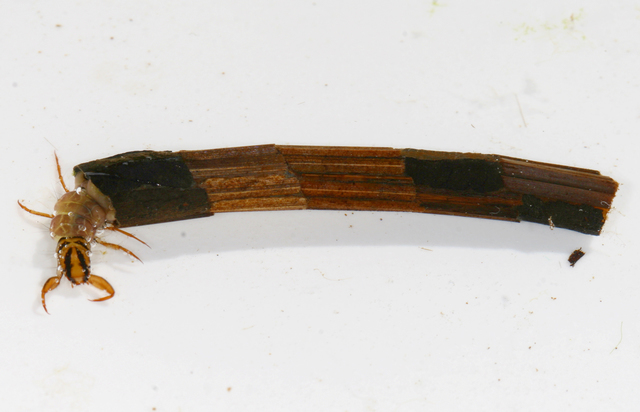
Both the larvae and adults are aberrant among other casemaking caddisfly families in their morphology and the odd architecture of the cases. As can be seen partially in the photo above, the case is a tapered tube of rock and leaf fragments, tethered to the substrate via a tough, silken stalk nearly as long as the case, and coated in tiny silk denticles. These predatory larvae extend their stout, hairy legs into the current like a net, snagging drifting insect larvae and other aquatic invertebrates. When it comes time to pupate, the larvae narrow the posterior end of the case, shorten the stalk, and build a wide collar around the anterior opening, possibly to help funnel water through the case. Some species will form their pupal houses in long chain like aggregations, with the stalks attached to the preceding cases (Wiggins 2004). Adult limnocentropodids are unique in retaining hardened mandibles; most caddisflies have only a sponge-like haustellum (Latin for "little suck") much like that of a house fly. (Kjer 2010).

A Limnocentropus himalayanus male. Despite being present, the mandibles are quite small and nearly undetectable in this photo. (Kjer 2006, Public Domain)


Because these stalk-casemakers are so weird, trichopterologists have had a hard time classifying this family. Glen Wiggins and Henry Frania (1997) placed Limnocentropodidae as a sister family to the rest of the case making caddisflies based in not possessing characters placing them in either the Brevitentoria (Herbert Ross's "long-horned-caddis-like" group) or the Plenitentoria ("northern-casemaker-like" group). More recent work using molecular characters (Kjer et al. 2002) and combined molecular and morphological characters (Holzenthal et al. 2007) supports placement within Brevitentoria, but any deeper classification has been unstable (Kjer 2010).


References

Frania, H. E., and G. B. Wiggins. 1997. Analysis of morphological and behavioural evidence for the phylogeny and higher classification of Trichoptera (Insecta). Life Sciences Contributions, Royal Ontario Museum, 160, 1–67.

Holzenthal, R. W., R. J. Blahnik, K. M. Kjer, and A. L. Prather. 2007. An update on the phylogeny of Caddisflies (Trichoptera). Proceedings of the XIIth International Symposium on Trichoptera. Bueno-Soria, R. Barba-Alvearz and B. Armitage (Eds). pp. 143-153. The Caddis Press.

Kjer, K. M. 2010. Limnocentropodidae. Limnocentropus. Version 20 July 2010 (under construction). http://tolweb.org/Limnocentropus/14593/2010.07.20 in The Tree of Life Web Project, http://tolweb.org/ [Accessed 17 February 2012].

Kjer, K. M., R. J. Blahnik, and R. W. Holzenthal. 2002. Phylogeny of Caddisflies (Insecta, Trichoptera), Zoologica Scripta 31(1) :83-91.

Morse, J. C. (ed.) 2012. Trichoptera World Checklist http://entweb.clemson.edu/database/trichopt/index.htm [Accessed 17 February 2012]

Wiggins, G. B. 2004. Caddisflies: The Underwater Architects. University of Toronto Press, Toronto, ON. [ed: includes detailed drawings of larval and case morphology]

Monday, October 24, 2011

Phryganeidae: The Giant Casemakers.

The Phryganeidae are a small family of caddisflies distributed throughout North America, Europe, and Asia. Wiggins (1996) lists the total as 15 genera and ~75 species; by my count from the World Trichoptera Checklist (Morse 2011) there are 80 extant and 37 fossil species. This family includes the largest known caddisflies. The larvae are case makers (as the common name suggests), and fashion tube cases of spiral or circular wrapped vegetation.
Oligostomis pardalis larva (© D.S. Chandler / Discover Life)

The genus name Phryganea has a long history of use, starting in the 10th edition of the Systema Naturae (Linnaeus 1758). Carl von Linne included 17 species of caddisflies in this work, all under the genus Phryganea (from the French word for caddisflies). Needless to say, most of these species have been removed to other families and genera. At the time, caddisflies, stoneflies, dragonflies and mayflies were all included under the order Neuroptera; it wasn't until 1813 that the Order Trichoptera was erected. Due to the original status of the genus, there are many nomenes dubius and synonyms that by far outnumber the species now in the entire family.

Banksiola dossuaria (© Trichoptera Barcode of Life)

In addition to large size (often greater than 25 mm), the adults are characterized by colorization ranging from the black and white checkers of Banksiola to the fall leaf orange of Ptilostomis to the yellow and dark purple of Eubasillissa. The largest species, Eubasillissa regina, is over 4 cm with an 7 to 8 cm wingspan. Dr. John Morse, who has spent much time collecting and studying aquatic insects in Southeast Asia, told me they look like a small bird with a strange flight pattern from afar.

Eubasilissa regina, the worlds largest caddisfly.

The larvae often have contrasting patterns of orange and black stripes on head and thorax, and are just as impressive as the adults in size. One of the most curious larval tendencies is the ease at which they leave their cases behind when disturbed. If one larva looses it's case and other of a similar size is occupied nearby, the two larvae will fight over the case (as illustrated in this video). Though they inhabit a wide variety of aquatic habitats, they are found most often around the roots and stems of aquatic vegetation, and in root balls of woody plants, with a diet of mostly aquatic invertebrates.

The definitive guide for the family is an eponymously named book by Glen Wiggins (1998), and despite being over ten years old is still in print and in demand. The book includes genus keys and diagnoses for all the species know at its publication, including all 28 North American species. Wiggins splits the family into the Yphriinae (which includes a single species of Yphria from Western North America), and the Phryganeinae, though the separation is drawn due to 'primitive characters' possessed by Yphria is to me not particularly convincing, and may be paraphyletic.


References

Morse, J.C. (ed.) 2011. Trichoptera World Checklist. http://entweb.clemson.edu/database/trichopt/index.htm [Accessed 24 October 2011.]

Wiggins GB. 1977. Larvae of the North American Caddisfly Genera. University of Toronto Press, Toronto, ON.

Wiggins, G.B. 1998. The Caddisfly Family Phryganeidae (Trichoptera). University of Toronto Press, Toronto, ON.