Today was the last day for early registration to the 2012 Society for Freshwater Science (formerly NABS) annual meeting in Louisville, Kentucky, and I squeezed in mine just in time. Since I was forced to state an "University/Organization", and I no longer have any affiliations, I just put down "freelance taxonomist". Hope that works.
This year's focus is on freshwater stewardship on a global scale. If you are familiar with the former incarnation of SFS, the North American Benthological Association, you'll know this international focus is recent. And NABS was the creation of the older Midwestern Benthological Society, founded in 1953. Back then, the focus was mostly on provincial aquatic invertebrate biology and ecology, with a large taxonomic component. Over the past 20 years the focus has become more inclusive, with an unfortunate decline in taxonomic contributions.
Still, I am looking forward to attending. Some of my thesis work is being published in a key to the mayflies, stoneflies, and caddisflies (EPT) of the Southeastern United States, and my mentor is giving a talk about it. There's also the taxonomy fair, which I hope will be well attended, and hopefully some taxonomy related sessions and posters. And of course I'll attend the sessions on biomonitoring and behavior. There is no information on individual talks at the moment, so I will update on my "must see events" when I get more information.
Will any of my readers be attending? If so, I look forward to seeing you there!
Saturday, March 31, 2012

Friday, March 30, 2012
"That's not Asindulum tenuipes, that's my wife!"
In Neal Evenhuis's Catalog of Keroplatidae of the World (PDF), he lists two described species of Asindulum as found in North America. This is a keroplatid genus of four described extant species, the other two in Europe and the Middle East, and four more fossil species found in Baltic amber. It's a distinctive genus among the mess which is the Orfellini, a tribe of closely related genera which are still being worked out. Both Asindulum and the sister genus Macrorrhyncha have long mouth parts, at least the length of the head. The only species studied in any detail, the Palearctic Asindulum nigrum, is known to feed from flowers of the parsley family (Apiaceae) (Betchev 2010).
 Asindulum or Macrorhyncha feeding from a flower. Since the separation is based on wing venation, and this specimen has it's wings folded, I'm not sure which genus. If you know the flower, please tell me! (CC Tom Murray)
Asindulum or Macrorhyncha feeding from a flower. Since the separation is based on wing venation, and this specimen has it's wings folded, I'm not sure which genus. If you know the flower, please tell me! (CC Tom Murray)As I may have mentioned previously, I'm in the very beginnings of working out the North American Keroplatidae. All the Nearctic fungus gnat families are sorely in need of revision, but I have made this group my darling. The first step in any revision is pooling the literature, and determining the condition of all the type specimens. The types are individual or series of specimens which the names are supposed to refer. I say "supposed to", because type specimens are often found damaged, mislabeled, or not found at all. Often the descriptions in the literature are enough that the identity of the species is not in question, even without a type. Other times, the only description was the original one, and the type is not available. If the species was named more than 100 years ago, that description may be essentially useless, and the type must be found to clarify the meaning behind the name. Otherwise, it will become a nomen dubium, a "doubtful name" which, although available under The Code, may not refer to anything meaningful.
So, I am one by one figuring out the providence of the North American keroplatid types, including the two species of Asindulum mentioned above. Asindulum montanum was described by the German dipterist Victor von Röder in 1887, and though the description is short and includes no useful illustrations, plenty of later taxonomists have identified members of this species. The male and female syntypes are housed in the Zoological Institute of Martin Luther University in Halle, Germany, and while I will still need to see them, I can at least rest assured they exist.
The other Nearctic species, Asindulum tenuipes, was more of a mystery. It is only mentioned once in the keroplatid literature, and that is in the original type description. The species was described by Francis Walker in 1848, a worker notorious for his method of describing species, which can be summed up as "piss poor". And indeed, the description gives us only minimal information and no illustrations. It's not even clear where the type is housed, although much of Walker's collections are at the Natural History Museum in London.
The only clue is in the name of the person who collected the type, a "G. Barnston, Esq". Further searching revealed that George Barnston (see painting here) was an Scottish fur trader employed by the Hudson Bay Company in the early 1800s. During his 42 year tenure with HBC he also engaged in naturalist study, including entomology and botany. The type of A. tenuipes, then, was undoubtedly collected during his time at St. Martin Falls on the Albany River, Ontario, from 1834-1840, since Walker lists this as the type location. In 1843-1844, Barnston took a year long furlough to England, and during this time donated his entire collection of insects to the British Museum (Brown and Van Kirk 2000). Despite Dr. Evenhuis listing the location of the type as unknown, I suspected it was still housed there.

So, I am one by one figuring out the providence of the North American keroplatid types, including the two species of Asindulum mentioned above. Asindulum montanum was described by the German dipterist Victor von Röder in 1887, and though the description is short and includes no useful illustrations, plenty of later taxonomists have identified members of this species. The male and female syntypes are housed in the Zoological Institute of Martin Luther University in Halle, Germany, and while I will still need to see them, I can at least rest assured they exist.
The other Nearctic species, Asindulum tenuipes, was more of a mystery. It is only mentioned once in the keroplatid literature, and that is in the original type description. The species was described by Francis Walker in 1848, a worker notorious for his method of describing species, which can be summed up as "piss poor". And indeed, the description gives us only minimal information and no illustrations. It's not even clear where the type is housed, although much of Walker's collections are at the Natural History Museum in London.
The only clue is in the name of the person who collected the type, a "G. Barnston, Esq". Further searching revealed that George Barnston (see painting here) was an Scottish fur trader employed by the Hudson Bay Company in the early 1800s. During his 42 year tenure with HBC he also engaged in naturalist study, including entomology and botany. The type of A. tenuipes, then, was undoubtedly collected during his time at St. Martin Falls on the Albany River, Ontario, from 1834-1840, since Walker lists this as the type location. In 1843-1844, Barnston took a year long furlough to England, and during this time donated his entire collection of insects to the British Museum (Brown and Van Kirk 2000). Despite Dr. Evenhuis listing the location of the type as unknown, I suspected it was still housed there.
An aerial photograph of the Albany River, Martin Falls, Ontario, the supposed type location of A. tenuipes. (Via the Martin Falls (Ogoki Post) community homepage)
I contacted Dr. Erica McAlister, the Diptera collections manager at the Natural History Museum in London (who, by the way, has an excellent blog). She was very helpful in my search. Yes, indeed, they have the type of A. tenuipes, and despite the giant pin nearly cleaving it's thorax in two, it's in pretty good condition. Also, would I like it imaged? (Oh, would I!)
Unfortunately, or maybe fortunately, imaging was unnecessary. Yes, this was the type labeled "Asindulum tenuipes". Yes, it was in good enough condition to photograph. Yes, it matches the type description. But this was not a keroplatid of any kind. This was in fact a blepharicerid.
 A net-winged midge (Blephariceridae) of the genus Agathon. Note: NOT a fungus gnat. (CC Tom Murray)
Unfortunately, or maybe fortunately, imaging was unnecessary. Yes, this was the type labeled "Asindulum tenuipes". Yes, it was in good enough condition to photograph. Yes, it matches the type description. But this was not a keroplatid of any kind. This was in fact a blepharicerid.
A net-winged midge (Blephariceridae) of the genus Agathon. Note: NOT a fungus gnat. (CC Tom Murray)This was not unknown. That Walker had made a mistake was not noted at the time of Vernon Kellog's North American revision of the Blephariceridae (1903), but it was known by 3 years later (Riley 1908). Indeed, the Blepharicera tenuipes Group of species has been the recent subject of close study (Moulton 2007, Jacobson 2010). The type of Asindulum tenuipes is now referred to Blepharicera tenuipes. And somewhere in the transition this bit of information was lost in the fungus gnat literature. I was consoled by Nigel Wyatt, the Curator of Diptera, that this is a normal occurrence with Walker types. "I don't find it at all surprising that Walker could have mistaken a blepharicerid for a fungus gnat", he told me, "working here and often dealing with Walker's type material I have found this level of mistake is not unusual!"
This whole exercise is illustrative of the winding pitfall strewn road that is taxonomic research. A taxonomist might search days, months, years for a single specimen, and when at last she comes upon it tucked away in a museum drawer, she finds it is not at all what she was looking for in the first place.
The MOST IMPORTANT THING is, when this happens, write it down. Don't make some other researcher come along and spend vital time digging up such a tidbit. Publish it in print, on-line, somewhere. Natural history progresses by the accumulation of knowledge, and that only works if we add to and organize the pile.
Works Cited
Bechev, D. 2010. Flower visitation of fungus gnats from the genera Antlemon, Asindulum and Macrorrhyncha (Diptera: Keroplatidae): published data and a new record. ZooNotes 7: 1-3.
Brown, J. S. H., and S. M. Van Kirk. 2000. Barnston, George - Dictionary of Canadian Biography Online. University of Toronto.![[WWW]](http://wikispot.org/wiki/eggheadbeta/img/sycamore-www.png) http://www.biographi.ca/009004-119.01-e.php?&id_nbr=5360
http://www.biographi.ca/009004-119.01-e.php?&id_nbr=5360
Evenhuis, N. L. 2006. Catalog of the Keroplatidae of the world. Bishop Museum Bulletin in Entomology 13, Bishop Museum Press, Honolulu.
Jacobson, A. J. 2010. Phylogenetic analysis of the Nearctic Blepharicera Macquart (Diptera: Blephariceridae) with an emphasis on the eastern Blepharicera tenuipes Group Hogue. PhD Dissertation, University of Tennessee - Knoxville.
Moulton, J. K., and G. R. Curler. 2007. A new species of net-winged midge of the genus Blepharicera Macquart (Diptera: Blephariceridae) from the cumberland plateau of Tennessee. Proceedings of the Entomological Society of Washington 109: 920-929.
Riley, W. A. 1908. The divided eyes of Blepharocera tenuipes Walker. pp. 280-281 in Howard, L. G. (ed.). Proceedings of the American Association for the Advancement of Science Fifty-Sixth and Fifty-Seventh Meetings. Gibson Brothers, Washington, D.C.
Walker, F. 1848. List of the specimens of dipterous insects in the collection of the British Museum. Part I. British Museum, London.
This whole exercise is illustrative of the winding pitfall strewn road that is taxonomic research. A taxonomist might search days, months, years for a single specimen, and when at last she comes upon it tucked away in a museum drawer, she finds it is not at all what she was looking for in the first place.
The MOST IMPORTANT THING is, when this happens, write it down. Don't make some other researcher come along and spend vital time digging up such a tidbit. Publish it in print, on-line, somewhere. Natural history progresses by the accumulation of knowledge, and that only works if we add to and organize the pile.
Works Cited
Bechev, D. 2010. Flower visitation of fungus gnats from the genera Antlemon, Asindulum and Macrorrhyncha (Diptera: Keroplatidae): published data and a new record. ZooNotes 7: 1-3.
Brown, J. S. H., and S. M. Van Kirk. 2000. Barnston, George - Dictionary of Canadian Biography Online. University of Toronto.
http://www.biographi.ca/009004-119.01-e.php?&id_nbr=5360Evenhuis, N. L. 2006. Catalog of the Keroplatidae of the world. Bishop Museum Bulletin in Entomology 13, Bishop Museum Press, Honolulu.
Jacobson, A. J. 2010. Phylogenetic analysis of the Nearctic Blepharicera Macquart (Diptera: Blephariceridae) with an emphasis on the eastern Blepharicera tenuipes Group Hogue. PhD Dissertation, University of Tennessee - Knoxville.
Moulton, J. K., and G. R. Curler. 2007. A new species of net-winged midge of the genus Blepharicera Macquart (Diptera: Blephariceridae) from the cumberland plateau of Tennessee. Proceedings of the Entomological Society of Washington 109: 920-929.
Riley, W. A. 1908. The divided eyes of Blepharocera tenuipes Walker. pp. 280-281 in Howard, L. G. (ed.). Proceedings of the American Association for the Advancement of Science Fifty-Sixth and Fifty-Seventh Meetings. Gibson Brothers, Washington, D.C.
Walker, F. 1848. List of the specimens of dipterous insects in the collection of the British Museum. Part I. British Museum, London.
Monday, March 19, 2012
Scientists-who-are-not-paid.
I absolutely love Nancy Collins's article in the new Spring issue of American Entomologist. She's a perfect example of a passionate naturalist, a taxonomic specialist of Ocanthinae (tree crickets). She has traveled the continent (and beyond), collecting, recording songs, and identifying specimens. Her website is excellent, with a level of detail and public outreach to serve as models for the rest of us. She is a scientist.
But I don't see why I need to talk about her as a "citizen scientist". She has published original research, worked in connection with other researchers, presented at professional meetings, and is an expert in her group. She's an autodidact, sure, but so is every other taxonomist; specialist taxonomy isn't exactly taught in classes. There's no "Orthoptera 101" course taught at university. I for one don't think there is a need for a disclaimer at the bottom of her website, saying her research "has no scientific basis".
Is there something I'm missing here, some sort of requirement that scientists must get paid to do scientific work in order to be (flat out) scientists? Am I the only one who thinks oxymoron when the phrase "professional amateur" appears in print?
I'm not knocking the intentions of the American Entomologist editors. This issue's focus on "citizen science" was a product of a special session from last year's annual meeting. It was meant to spotlight entomological research going on outside of academia, which is good and right and noble. And I know they didn't mean anything insulting by it.
But when people of any age do good scientific research, paid or unpaid, within or outside of academia they are not "citizen-scientists" or "para-taxonomists", they are just scientists and taxonomists. They are certainly not "amateurs", as their knowledge attests to work equaling "professionals". I can't be the only one who finds this condescension like head patting when a child scores high on an exam. I value Nancy's research higher than that. We don't need to qualify it as somehow different.
Or if you must, 'taxahacker' is acceptable. Though, some people may find that offensive for other reasons.
But I don't see why I need to talk about her as a "citizen scientist". She has published original research, worked in connection with other researchers, presented at professional meetings, and is an expert in her group. She's an autodidact, sure, but so is every other taxonomist; specialist taxonomy isn't exactly taught in classes. There's no "Orthoptera 101" course taught at university. I for one don't think there is a need for a disclaimer at the bottom of her website, saying her research "has no scientific basis".
Is there something I'm missing here, some sort of requirement that scientists must get paid to do scientific work in order to be (flat out) scientists? Am I the only one who thinks oxymoron when the phrase "professional amateur" appears in print?
I'm not knocking the intentions of the American Entomologist editors. This issue's focus on "citizen science" was a product of a special session from last year's annual meeting. It was meant to spotlight entomological research going on outside of academia, which is good and right and noble. And I know they didn't mean anything insulting by it.
But when people of any age do good scientific research, paid or unpaid, within or outside of academia they are not "citizen-scientists" or "para-taxonomists", they are just scientists and taxonomists. They are certainly not "amateurs", as their knowledge attests to work equaling "professionals". I can't be the only one who finds this condescension like head patting when a child scores high on an exam. I value Nancy's research higher than that. We don't need to qualify it as somehow different.
Or if you must, 'taxahacker' is acceptable. Though, some people may find that offensive for other reasons.
Sunday, March 4, 2012
YAGS, and why it is good for natural history.
I recently came across the term YAGS (Yet Another Genome Syndrome) in reference to the iceman genome sequence. I originally empathized with the sentiment, that genome sequencing has been done, and that the hype over new genome sequences is unfounded. But I have since revised my position.
Ultimately, YAGS is a sign that people are bored with genome sequencing, that it is no longer SHINY and new use of technology. It has become 'cataloging'.
This excites me.
If genome sequences have become a "mundane" descriptive enterprise rather than an experimental use of technology, it has become ideographic science. It has become natural history. Genome description, then, continues as an exercise on par with morphological description, something with which all taxonomists are familiar. With soon to be 4th generation nanopore sequencing, I could in a few hours have the sequence to any of those insects which have been ignored by geneticists. I could have a sequence, for around 900 USD, of any caddisfly I wanted. What has become boring for the futurists is exciting new ground for naturalists. Because it is when a large mass of genomes are assembled, when these individual papers build on each other, then patterns will become evident.
Another tool in the toolbox, nearly ours for the taking.
Ultimately, YAGS is a sign that people are bored with genome sequencing, that it is no longer SHINY and new use of technology. It has become 'cataloging'.
This excites me.
If genome sequences have become a "mundane" descriptive enterprise rather than an experimental use of technology, it has become ideographic science. It has become natural history. Genome description, then, continues as an exercise on par with morphological description, something with which all taxonomists are familiar. With soon to be 4th generation nanopore sequencing, I could in a few hours have the sequence to any of those insects which have been ignored by geneticists. I could have a sequence, for around 900 USD, of any caddisfly I wanted. What has become boring for the futurists is exciting new ground for naturalists. Because it is when a large mass of genomes are assembled, when these individual papers build on each other, then patterns will become evident.
Another tool in the toolbox, nearly ours for the taking.
Sunday, February 26, 2012
The fly with the feathery antennae.
In 2009, my mentor was part of an ecosystem survey project at Lago Copa, a recently created national park in Chile. He was using Townes traps to collect adult caddisflies, but he also kept representatives from other groups, including Diptera. When he returned I volunteered to sort out the caddisflies (these were alcohol-preserved samples he hand picked in the field), and I also sorted out any fungus gnats I found. The gestalt for many fungus gnats is easy enough to pick them out around other flies, even without magnification. They tend to have long antennae, long coxae and legs, multiple tibial spurs, a thin, curving abdomen that widens towards the tip, and often have patterned wings. They also tend to be laterally flattened, which sets them off from the boxy muscoid flies. In particular, I was looking for members of the family Keroplatidae, some of which have stout, flattened antennae as well as the above characters. If I had to describe the over all shape in simple terms, they look like two arches joined by three pillars, with wings outstretched behind.
 The mystery fly, semi-left habitus. CHILE: PROVINCIA AYSEN: Municipalidad Cisnes, Parque Nacional Lago Copa, S. side of E. Lago Copa, unnamed 1st order stream, from cascade 200 m E. of Cliffs Lodge, S44.89155, W072.62070, 15-18.xii.2009.

The hindlegs are like nothing I had seen before. The tibiae are bowed and pressed forward in a grove against the femurs, so the tarsi lay close to the coxae. They resembled those of chalcid parasitoid wasps, which use those strong hind legs to capture prey for their young. The abdomen is short and conic. And the wings confuse the rest.

Imagine my surprise when I found this critter among the mix.
 The mystery fly, semi-left habitus. CHILE: PROVINCIA AYSEN: Municipalidad Cisnes, Parque Nacional Lago Copa, S. side of E. Lago Copa, unnamed 1st order stream, from cascade 200 m E. of Cliffs Lodge, S44.89155, W072.62070, 15-18.xii.2009.
If this was a fungus gnat, it was the strangest individual I had ever seen. First of all, the antennae are pectinate (feather-like), and there are few Diptera which have this character. This wouldn't eliminate Sciaroidea from the search, since there are genera in Ditomyiidae, Mycetophilidae, and Keroplatidae with species bearing pectinate antennae (Matile 1981). But then there are the other unusual characters.

The hindlegs are like nothing I had seen before. The tibiae are bowed and pressed forward in a grove against the femurs, so the tarsi lay close to the coxae. They resembled those of chalcid parasitoid wasps, which use those strong hind legs to capture prey for their young. The abdomen is short and conic. And the wings confuse the rest.

The wing veination looks as if it could have come from a fungus gnat, but the thick apical stigma and just how strong the veins are, how dark and heavy, reminds me more of a wasp wing. The halters mean it is obviously a true fly, but it looks like someone has glued on parts from other insect orders. I sent some pictures to Sciaroidea experts but the identity of this chimera continued to be a mystery.
I finally sent the above photos to Dalton de Souza Amorim, a South American fly expert, and he replied with a diagnosis he was nearly 100% sure of. But this was not a fungus gnat. It wasn't even in the Sciaroidea superfamily. This was a Canthyloscelidae.

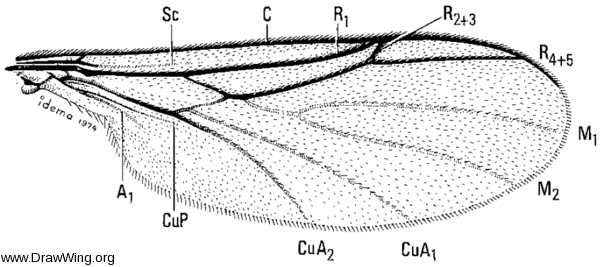
Wing of male Exiliscelis californiensis from the Synneuridae chapter of Manual of Nearctic Diptera. (Via DrawWing) If I didn't know better, I would say this came from a keroplatid.
I finally sent the above photos to Dalton de Souza Amorim, a South American fly expert, and he replied with a diagnosis he was nearly 100% sure of. But this was not a fungus gnat. It wasn't even in the Sciaroidea superfamily. This was a Canthyloscelidae.

Wing of male Exiliscelis californiensis from the Synneuridae chapter of Manual of Nearctic Diptera. (Via DrawWing) If I didn't know better, I would say this came from a keroplatid.
The family Canthyloscelidae is a small family of flies in the "lower" Diptera, with ~15 extant species in 4 genera, found native in all faunal regions except the East Palearctic and Afrotropics. There is disagreement as to whether it should be placed with the Bibiomorpha or Psychodomorpha; larval structures suggest the latter (Amorim 2008) while adult characters alone suggest the former. Canthyloscelidae used to be split into two or more families, the Synneuridae and Canthyloscelidae (sometimes previously combined under Hyperoscelidae (Hutson 1977)), but these were joined by the time of Haenii's canthyloscelid chapter in Contributions to a Manual of Palearctic Diptera (1997).
This particular species is Canthyloscelis pectinata, the only species in this family with the males bearing strongly pectinate antennae. It has been recorded from Argentina and Chile in very low numbers (Hutson 1977), which means this may be one of less than 20 specimens ever collected, a rare find (Amorim pers. com.).
 Exiscelis californiensis gathering on Potentilla flowers, Lowder Mountain, Oregon. (© 2011 Jake Hurlbert)
This particular species is Canthyloscelis pectinata, the only species in this family with the males bearing strongly pectinate antennae. It has been recorded from Argentina and Chile in very low numbers (Hutson 1977), which means this may be one of less than 20 specimens ever collected, a rare find (Amorim pers. com.).
Exiscelis californiensis gathering on Potentilla flowers, Lowder Mountain, Oregon. (© 2011 Jake Hurlbert)
In North America, there are two species of Canthyloscelidae in two genera, Synneuron decepiens and Exiscelis californiensis. S. decepiens is found at Northern latitudes across the continent, while E. californiensis is only found on the Northwest Coast. Both are found in "ancient forests" (Triplehorn and Johnson 2004). Very little is known about their biology; larvae live in decaying wood "permeated by [fungal] mycelia" (Peterson and Cook 1981), and this family's close relationship with Scatopsidae suggests they feed on the fungi and microorganisms associated with such habitats.
In all, it was a nice little treasure hunt. I think taking time to jump outside my comfort zone and identify something so strange to my experience is an excellent exercise. It improves my skill as a taxonomist and teaches me about groups beyond my research. But most of all, identifying something weird is /fun/. Finding something strange and new, even if it's just new to you, is one of the greatest pleasures of natural history research.
References
Haenni, J.-P. 1997. Family Canthyloscelidae. In Papp L. & Darvas B. (eds): Contributions to a Manual of Palaearctic Diptera. Nematocera and Lower Brachycera.. Vol. 2. Budapest: Science Herald. pp. 273–279.
Hutson, A. M. 1977. A revision of the families Synneuridae and Canthyloscelidae (Diptera). Bulletin of the British Museum (Natural History) Entomology 35(3):67-100.
Johnson, N. F., and C. A. Triplehorn. 2004. Borror and Delong's Introduction to the Study of Insects, 7th ed. Brooks Cole, St. Paul, MN.
Matile, L. 1981. A new Austrailian genus of Keroplatidae with pectinate antennae (Diptera: Mycetophiloidea). Journal of the Austrailian Entomological Society 20: 207-212.
Peterson, B. V., and E. F. Cook. 1981. Chapter 21. Synneuridae. Manual of Nearctic Diptera 1: 321-324.
In all, it was a nice little treasure hunt. I think taking time to jump outside my comfort zone and identify something so strange to my experience is an excellent exercise. It improves my skill as a taxonomist and teaches me about groups beyond my research. But most of all, identifying something weird is /fun/. Finding something strange and new, even if it's just new to you, is one of the greatest pleasures of natural history research.
References
Haenni, J.-P. 1997. Family Canthyloscelidae. In Papp L. & Darvas B. (eds): Contributions to a Manual of Palaearctic Diptera. Nematocera and Lower Brachycera.. Vol. 2. Budapest: Science Herald. pp. 273–279.
Hutson, A. M. 1977. A revision of the families Synneuridae and Canthyloscelidae (Diptera). Bulletin of the British Museum (Natural History) Entomology 35(3):67-100.
Johnson, N. F., and C. A. Triplehorn. 2004. Borror and Delong's Introduction to the Study of Insects, 7th ed. Brooks Cole, St. Paul, MN.
Matile, L. 1981. A new Austrailian genus of Keroplatidae with pectinate antennae (Diptera: Mycetophiloidea). Journal of the Austrailian Entomological Society 20: 207-212.
Peterson, B. V., and E. F. Cook. 1981. Chapter 21. Synneuridae. Manual of Nearctic Diptera 1: 321-324.
Friday, February 17, 2012
Limnocentropodidae: The Tethered Casemakers.
Limnocentropodidae is a small family of case making caddisflies distributed throughout the East Palearctic, from Nepal to Japan, to India and Indonesia in the South. The family consists of a single genus, Limnocentropus, containing 15 described species (Trichoptera World Checklist, 2012). Larvae are filter feeders in streams and rivers (sometimes torrential currents), facing head and legs first into the current much like the common Nearctic genus Brachycentrus (Brachycentridae), but it is there that any similarities to other casemaking caddisfly families end.
 A Limnocentropus insolitus larva, from Haiya, Kyoto Prefecture, Japan. The photographer calls it a "kita gami", the Japanese name for the group. (© 2011 hir**amiyam*)
References
Frania, H. E., and G. B. Wiggins. 1997. Analysis of morphological and behavioural evidence for the phylogeny and higher classification of Trichoptera (Insecta). Life Sciences Contributions, Royal Ontario Museum, 160, 1–67.
Holzenthal, R. W., R. J. Blahnik, K. M. Kjer, and A. L. Prather. 2007. An update on the phylogeny of Caddisflies (Trichoptera). Proceedings of the XIIth International Symposium on Trichoptera. Bueno-Soria, R. Barba-Alvearz and B. Armitage (Eds). pp. 143-153. The Caddis Press.
Kjer, K. M. 2010. Limnocentropodidae. Limnocentropus. Version 20 July 2010 (under construction). http://tolweb.org/Limnocentropus/14593/2010.07.20 in The Tree of Life Web Project, http://tolweb.org/ [Accessed 17 February 2012].
Kjer, K. M., R. J. Blahnik, and R. W. Holzenthal. 2002. Phylogeny of Caddisflies (Insecta, Trichoptera), Zoologica Scripta 31(1) :83-91.
Morse, J. C. (ed.) 2012. Trichoptera World Checklist http://entweb.clemson.edu/database/trichopt/index.htm [Accessed 17 February 2012]
Wiggins, G. B. 2004. Caddisflies: The Underwater Architects. University of Toronto Press, Toronto, ON. [ed: includes detailed drawings of larval and case morphology]
 A Limnocentropus insolitus larva, from Haiya, Kyoto Prefecture, Japan. The photographer calls it a "kita gami", the Japanese name for the group. (© 2011 hir**amiyam*)
Both the larvae and adults are aberrant among other casemaking caddisfly families in their morphology and the odd architecture of the cases. As can be seen partially in the photo above, the case is a tapered tube of rock and leaf fragments, tethered to the substrate via a tough, silken stalk nearly as long as the case, and coated in tiny silk denticles. These predatory larvae extend their stout, hairy legs into the current like a net, snagging drifting insect larvae and other aquatic invertebrates. When it comes time to pupate, the larvae narrow the posterior end of the case, shorten the stalk, and build a wide collar around the anterior opening, possibly to help funnel water through the case. Some species will form their pupal houses in long chain like aggregations, with the stalks attached to the preceding cases (Wiggins 2004). Adult limnocentropodids are unique in retaining hardened mandibles; most caddisflies have only a sponge-like haustellum (Latin for "little suck") much like that of a house fly. (Kjer 2010).
 A Limnocentropus himalayanus male. Despite being present, the mandibles are quite small and nearly undetectable in this photo. (Kjer 2006, Public Domain)
Because these stalk-casemakers are so weird, trichopterologists have had a hard time classifying this family. Glen Wiggins and Henry Frania (1997) placed Limnocentropodidae as a sister family to the rest of the case making caddisflies based in not possessing characters placing them in either the Brevitentoria (Herbert Ross's "long-horned-caddis-like" group) or the Plenitentoria ("northern-casemaker-like" group). More recent work using molecular characters (Kjer et al. 2002) and combined molecular and morphological characters (Holzenthal et al. 2007) supports placement within Brevitentoria, but any deeper classification has been unstable (Kjer 2010).
 A Limnocentropus himalayanus male. Despite being present, the mandibles are quite small and nearly undetectable in this photo. (Kjer 2006, Public Domain)
References
Frania, H. E., and G. B. Wiggins. 1997. Analysis of morphological and behavioural evidence for the phylogeny and higher classification of Trichoptera (Insecta). Life Sciences Contributions, Royal Ontario Museum, 160, 1–67.
Holzenthal, R. W., R. J. Blahnik, K. M. Kjer, and A. L. Prather. 2007. An update on the phylogeny of Caddisflies (Trichoptera). Proceedings of the XIIth International Symposium on Trichoptera. Bueno-Soria, R. Barba-Alvearz and B. Armitage (Eds). pp. 143-153. The Caddis Press.
Kjer, K. M. 2010. Limnocentropodidae. Limnocentropus. Version 20 July 2010 (under construction). http://tolweb.org/Limnocentropus/14593/2010.07.20 in The Tree of Life Web Project, http://tolweb.org/ [Accessed 17 February 2012].
Kjer, K. M., R. J. Blahnik, and R. W. Holzenthal. 2002. Phylogeny of Caddisflies (Insecta, Trichoptera), Zoologica Scripta 31(1) :83-91.
Morse, J. C. (ed.) 2012. Trichoptera World Checklist http://entweb.clemson.edu/database/trichopt/index.htm [Accessed 17 February 2012]
Wiggins, G. B. 2004. Caddisflies: The Underwater Architects. University of Toronto Press, Toronto, ON. [ed: includes detailed drawings of larval and case morphology]
Monday, February 6, 2012
Entomological Museums: Little progress in 60 years.
At the 1949 meeting of the Pacific Coast Entomological Society, retiring president Edward S. Ross gave an address on the role of entomological museums. He outlined six major functions which can be applied to natural history collections in general.
1. To preserve specimens: "In thus preserving and making available for use the specimens upon which the literature is is based the museum performs one of its most important functions; namely, that of being a place where collections can be received curated, and preserved for future reference."
2. To serve as gathering point for newly collected and unstudied specimens: "When a museum fails to gather new material it is as dead and as unproductive as a machine without fuel."
3. To provide facilities and loan material for specialists:
5. To provide representative sets of specimens for major groups around the world: "In many orders higher categories have been very incompletely correlated from a world standpoint. There is a need for first hand examination, not a mere literature knowledge, of the type species upon which these categories are based."
6. To educate the public: "Very often [the museum] is the only place where youth, the post-university-age amateur, and the professional entomologist can find the means for pursuing his work...Avocational entomology can add to the fullness of many a life and this fact alone could well justify the place of museums in our society."
The major problem with meeting these functions, he said, "is financial support of the activity is more in proportion to the size of the organisms, than to the size of the job." Charismatic megafauna such as birds and mammals often receive greater funding, despite smaller amounts of taxonomic work needed in those groups. And in the eyes of the public, these tasks lack the shiny, new appeal of other sciences based in high technology. Shortages in staffing, space and organizing materials are due to museum work being "like that of a library...very unspectacular."
To Dr. Ross, the single most important progressive change needed was freer loaning of type specimens between institutions, with a central filing system containing information on the types for all names of insects worldwide. The most controversial aspect of his proposal was a central type depository, perhaps at the Smithsonian, where all holotype specimens collected in the United States would be located.
Thanks to Doug Yanega of the Entomological Collections Network listserv for the tip-up to this article.
Reference:
Ross, E. 1950. The Role of the Entomological Museum. Pan-Pacific Entomologist 26: 1-10.
1. To preserve specimens: "In thus preserving and making available for use the specimens upon which the literature is is based the museum performs one of its most important functions; namely, that of being a place where collections can be received curated, and preserved for future reference."
2. To serve as gathering point for newly collected and unstudied specimens: "When a museum fails to gather new material it is as dead and as unproductive as a machine without fuel."
3. To provide facilities and loan material for specialists:
All museums, of course, attempt to have table space and equipment for visiting scientists...Obviously, however, it is impossible for a specialist personally to visit each museum in the course of a given taxonomic project...Curators, because of pressure of other work, or a fewar of losing specimens, unfortunately are not always eager to fill loan requests. They should realize, however, that it is one of their primary duties to honor any loan request made by a worker in good standing, or who is properly recommended. Unstudied specimens lying idle in museums at a time when revisionary work is being done might just as well be back in the field if they are not utilized during such fleeting periods of activity.4. To specialize (to some extent) in a particular group or region: "The resultant development of outstanding collections in a taxonomic group is a desirable and an essential step towards making real published conclusions."
5. To provide representative sets of specimens for major groups around the world: "In many orders higher categories have been very incompletely correlated from a world standpoint. There is a need for first hand examination, not a mere literature knowledge, of the type species upon which these categories are based."
6. To educate the public: "Very often [the museum] is the only place where youth, the post-university-age amateur, and the professional entomologist can find the means for pursuing his work...Avocational entomology can add to the fullness of many a life and this fact alone could well justify the place of museums in our society."
The major problem with meeting these functions, he said, "is financial support of the activity is more in proportion to the size of the organisms, than to the size of the job." Charismatic megafauna such as birds and mammals often receive greater funding, despite smaller amounts of taxonomic work needed in those groups. And in the eyes of the public, these tasks lack the shiny, new appeal of other sciences based in high technology. Shortages in staffing, space and organizing materials are due to museum work being "like that of a library...very unspectacular."
To Dr. Ross, the single most important progressive change needed was freer loaning of type specimens between institutions, with a central filing system containing information on the types for all names of insects worldwide. The most controversial aspect of his proposal was a central type depository, perhaps at the Smithsonian, where all holotype specimens collected in the United States would be located.
It is clear after 60 years that this dream is far from being realized. The problems of staff and funding shortages are the same today as they were then, if not worse. And central type depositories aside, there is still no central database of names and types for insects. This is in spite of the ubiquity of Internet, and many independent attempts by taxonomists in their groups of specialization. Many museums are digitizing their collections, but these catalogs are institutional and seldom connected to each other. Despite technological progress, natural history collections have a long way to go before name and type information is completely available. The problems of today are the same as then.
I am sure the immediate reaction of many curators to this proposal will be one of horror, but most of this horror I believe would be based on unscientific selfish reasons. it is not the purpose of types to make an institutional or private collection valuable or indispensable. Admittedly it would mean that some museums would give up more than others. As matters stand, however, no institution is self-sufficient in regard to types and all stand to gain in the long run. What is really important is that our ponderous science would advance more rapidly with unwavering, steady steps. [emphasis his]
Thanks to Doug Yanega of the Entomological Collections Network listserv for the tip-up to this article.
Reference:
Ross, E. 1950. The Role of the Entomological Museum. Pan-Pacific Entomologist 26: 1-10.
Subscribe to:
Posts (Atom)