
No, this isn't about the calming powers of butterflies. The Nature Plus Beetle Blog has an excellent post of relaxing beetles using a kitchen steamer. Usually, entomologists use these glass hydration chambers, but this is an excellent idea for hard bodied insects. I especially like the use of thyme oil as an anti-fungal. 10 minutes apparently is all it takes to hydrate a batch of beetles to the point where they won't be damaged in mounting. It's also a good explanation of point mounting.
I would really like to see a post by someone on removing insects from alcohol to be pinned. I've experimented with xylene and 100% ethanol, but neither of these is satisfactory for Diptera or Trichoptera. I've heard good things about HMDS (hexamethyldisilazane), but I've never been able to get my hands on any to try it out.
Monday, November 7, 2011

Tuesday, November 1, 2011
A General Reference System: the goal of biological nomenclature.
Recently, I read this post by artist James Prosek on the failure of scientific names to capture the beauty and diversity he saw in his subjects, fish and birds. And while I generally agree with assessment that past authorities should not be taken at face value, I'm struck by the same sort of discontent at changing taxonomy as I read in Naming Nature. In both there is a tendency to dismiss biological nomenclature as unnecessary or not based in reality, an appeal to emotional response similar to the story Richard Feynman told about his artist friend. The name only adds to the beauty of the organism, because the name, really, all names in biology, act as a general reference system for information about organisms and their relationships.
A general reference system is the ultimate purpose of taxonomy as a science, as proposed by Willi Hennig in Biological Systematics (1966). And it has unfortunately been limited in advancement recently by many molecular studies that do not even attempt to put names on their hypothetical taxa. Often these are done for some particular purpose, to assist some particular investigation, but as Quentin D Wheeler points out, taxonomy is at its best when done for it's own sake, in investigation of the diversity of life as the distribution of that diversity (characters), and ultimating in a general reference system for all biology.
So what is a 'general reference system', and what makes a good one? David Allen of the famous (or infamous, depending on your inclination) Getting Things Done productivity method suggests building a reference filing system that is both simple and dynamic, so that any one piece of information could be filed in only a few places. Limiting the complexity means that files can be quickly and easily removed and rearranged as needed. Though more complicated than Allen's system, the International Codes of Nomenclature attempt a stable yet dynamic system for holding information about biodiversity by assigning unique identifiers (scientific names) and rules on how to apply them. But the complete, best reference system goes deeper than just assigning unique names; we don't, for example, organize our names alphabetically. For a higher reason, we put the names in a branching hierarchy of groups. The reason for this, of course, is evolution.
As Hennig explained, the general reference system should map the known lineages of life, and therefore hold information not only in the nodes (the names of species or higher taxa) but also in the pattern of the hierarchy. This fulfills Darwin's hope that 'descent with modification' would be integrated into all fields of study in natural history sciences, and that "[o]ur classifications will come to be, as far as they can be so made, genealogies" (Chapter 14, On the Origin of Species).
In the light of Evolution, the best general reference system will have three qualities: it will be descriptive, it will predict, and it will explain. It describes, through the pattern of the hierarchy, what we know so far of the phylogeny: which species are most closely related, which groups all share close common ancestors, which lineages have which characters, both molecular and morphological. It predicts the distribution of characters in organisms that are yet not fully know to us; since all mammals feed their young with milk secreting glands post-natally, we would hypothesize any newly discovered mammal would do the same. Likewise, we would hypothesize that any newly discovered insect would have 6 legs and three major body segments. Or that a new grasshopper would be plant feeding. We can predict that a new species of Wolffia is a flowering plant, despite the flowers being rare and nearly impossible to find. And finally, it explains the distribution of characters and diversity of life, and provides hypotheses towards explaining the routes of evolution of those characters. This is why monophyletic groupings are so important; whenever a paraphyletic or polyphyletic group is coined, the system looses predictive and explanatory power.
The general reference system is a tool, THE tool, the ULTIMATE tool of the biologist. It's the filing system that makes everything work. And the names that disturb the umwelt and bother molecular systematists are what keep track of all this information, all the information ever written about every group and relationship. Through the biological species concept we know the reality of species and through systematics we know the reality of their relationships. The general reference system of biological nomenclature ties these together and only adds to the beauty of every organism.
Monday, October 31, 2011
Inkscape tutorial for taxonomists.
If my readers are anything like me, we are all often disappointed with the way our line drawings turn out. I spend hours with a microscope, freehand drawing with a gridded eye piece, trace and ink on vellum, scan to computer, clean up in GIMP, and hope that the finished product is passable. My illustrations tend to be pixellated and messy after rescaling. What was that again, a harpago or a seta?
The expensive alternative is making a basic line drawing (no inking, no clean up), scanning and importing the image into Adobe Illustrator, and tracing a vector image from the hand drawing. I say expensive because Illustrator will run you about $450 USD; roughly the same amount as a new Asus Eee PC netbook. At the moment I don't have that kind of money, which I expect is true for most taxahackers and pro-am entomologists. For those of you who can afford the CS software suite, Dr. Ralph Holzenthal has an excellent guide to the program for entomologists.
I recently found Inkscape to be an excellent, inexpensive alternative to Illustrator. The software is a free, open source vector image program which can operate on Windows, Mac OS, and Linux platforms, and it can do almost everything that Illustrator can do with a few exceptions. In addition, continuous updates mean the tools are constantly improving.
In the rest of this post I'll be presenting my basic methods for line drawing illustration in Inkscape. Before you use this, I'd suggest doing some of the tutorials on this page, or at least completing the kokeshi doll tutorial. Once you know these basics, the rest of this post will make sense.
Line Drawing Tutorial in Inkscape
1. Before you even open inkscape, you need your drawing or other image scanned and saved as some sort of image file. Jpeg, tiff, or bmp works best.
2. Open inkscape, go to File > Import, and select your image from file. The drawing will be imported directly into the open Inkscape window.
3. First, you probably want to resize the image to the area of the 8x11 provided. This will make it easier for when you make plates with other images for publication.
4. Open up the Layers and Fill and Stroke tooboxes (ctrl+shift+L and ctrl+shift+F, respectively). It's good to have these two open at all times, because you will be shifting back and forth between them repeatedly.
5. In Layers, right click Layer 1 and add a new layer, above the original layer. Make Layer one about 50% opacity with the slide bar below, so you can tell the difference between your original and the vectors you are laying on top. If you are not actively working on a particular layer, it's best to click the lock icon next to the layer name to keep any changes from being made. The eye icon makes the highlighted layer invisible, which is useful for checking how your vector image compares to the original as you progress.
6. If your image isn't bilaterally symetrical, you're ready to start with the outlines. If however it is symmetrical, there is a simple way you can preserve symmetry. In the original layer, draw a line through the center of the illustration using the bezier tool, and make sure it's vertical or horizontal by holding control. Now rotate the image using the general selection tool so that it runs through the center of the drawing symmetrically. Now your work is cut in half, because you only have to trace half the drawing! When one half is done (details and all), just duplicate (ctrl+d) and flip the duplicate, and line them up opposite, then group them using ctrl+g.
7. The first step in any image is tracing the outline and major inner lines with the bezier tool. This works best if you try to straddle curves portions with nodes, as this will make the curves smoother. Once you've finished a portion, select the nodes and click the "make selected nodes auto-smooth" button on the top toolbar. Now adjust the curves so they match the lines underneath using the edit paths tool. You can adjust the width of the lines in the fill and stroke toolbar, under the stroke style tab. I tend to use several sizes throughout the drawing, wider for outlines and heavily sclerotized regions, thinner for structures within the outline and membrane.
8. Once the lines are done, it's time to fill in the details. Since fill shadings can get expensive in publications, I tend to use stippling. The easiest way to do this is to make a small circle with the circle tool the size you want the stiples, trace object to path (ctrl+shift+c), drag it across the drawing and press spacebar where you want the dots. If you drag and press spacebar, you can 'stamp' any path on your illustration, which can be useful for repetative details. I recommend making different layers for outline, shading, inner structures, setae, and annuli, as well as any other major details, so you can't alter or interfere with what you've already done while working on the next part.
9. Inner structures (those that would be on the interior of the specimen but are shown as if the surface is transparent) can be traced using the stippling as above, or traced as a path with the bezier tool and in stroke style, change the line in the dashes drop down menu to a dotted or dashed line, according to your preference. In my experience, the line width should be comparable to the outline line width, or the dots won't show very well.
10. Setae, and their corresponding basal annuli, are by far the most difficult detail to work in Inkscape. Unlike Illustrator, Inkscape does not yet have a custom brushes ability, so all setae have to be crafted, resized and placed by hand. Despite this issue, I've developed a work around.
12. Labels can be added with the text tool on the sidebar, and resized and rotated just as any other path. I suggest waiting to add these till all your illustrations are in plates so the labels and figure numbers are all the same size.
13. Once all the details are done, resize as necessary, set the original layer (the one with the hand drawing) to invisible, and save the illustration as an svg file.
14. Vector files are great as working illustrations, but to put them in a word processing document as a picture, they have to be converted into something more normal. Export the image as a bitmap using shift+ctrl+e. You can choose the width and height, as well as the density of pixels per inch (dpi). For now, I suggest something between 800 and 1000 dpi. Exporting will save the picture as a bitmap file with your specified settings. You can easily convert the bitmap to a jpeg or tiff by saving it as such in GIMP.
I guarantee your illustrations will look better than ever using this program. There are all kinds of ways you can tweek the image and details beyond the basic methods above, including ways I haven't discovered yet.
The expensive alternative is making a basic line drawing (no inking, no clean up), scanning and importing the image into Adobe Illustrator, and tracing a vector image from the hand drawing. I say expensive because Illustrator will run you about $450 USD; roughly the same amount as a new Asus Eee PC netbook. At the moment I don't have that kind of money, which I expect is true for most taxahackers and pro-am entomologists. For those of you who can afford the CS software suite, Dr. Ralph Holzenthal has an excellent guide to the program for entomologists.
I recently found Inkscape to be an excellent, inexpensive alternative to Illustrator. The software is a free, open source vector image program which can operate on Windows, Mac OS, and Linux platforms, and it can do almost everything that Illustrator can do with a few exceptions. In addition, continuous updates mean the tools are constantly improving.
In the rest of this post I'll be presenting my basic methods for line drawing illustration in Inkscape. Before you use this, I'd suggest doing some of the tutorials on this page, or at least completing the kokeshi doll tutorial. Once you know these basics, the rest of this post will make sense.
Line Drawing Tutorial in Inkscape
1. Before you even open inkscape, you need your drawing or other image scanned and saved as some sort of image file. Jpeg, tiff, or bmp works best.
2. Open inkscape, go to File > Import, and select your image from file. The drawing will be imported directly into the open Inkscape window.
3. First, you probably want to resize the image to the area of the 8x11 provided. This will make it easier for when you make plates with other images for publication.
4. Open up the Layers and Fill and Stroke tooboxes (ctrl+shift+L and ctrl+shift+F, respectively). It's good to have these two open at all times, because you will be shifting back and forth between them repeatedly.
5. In Layers, right click Layer 1 and add a new layer, above the original layer. Make Layer one about 50% opacity with the slide bar below, so you can tell the difference between your original and the vectors you are laying on top. If you are not actively working on a particular layer, it's best to click the lock icon next to the layer name to keep any changes from being made. The eye icon makes the highlighted layer invisible, which is useful for checking how your vector image compares to the original as you progress.
6. If your image isn't bilaterally symetrical, you're ready to start with the outlines. If however it is symmetrical, there is a simple way you can preserve symmetry. In the original layer, draw a line through the center of the illustration using the bezier tool, and make sure it's vertical or horizontal by holding control. Now rotate the image using the general selection tool so that it runs through the center of the drawing symmetrically. Now your work is cut in half, because you only have to trace half the drawing! When one half is done (details and all), just duplicate (ctrl+d) and flip the duplicate, and line them up opposite, then group them using ctrl+g.
7. The first step in any image is tracing the outline and major inner lines with the bezier tool. This works best if you try to straddle curves portions with nodes, as this will make the curves smoother. Once you've finished a portion, select the nodes and click the "make selected nodes auto-smooth" button on the top toolbar. Now adjust the curves so they match the lines underneath using the edit paths tool. You can adjust the width of the lines in the fill and stroke toolbar, under the stroke style tab. I tend to use several sizes throughout the drawing, wider for outlines and heavily sclerotized regions, thinner for structures within the outline and membrane.
8. Once the lines are done, it's time to fill in the details. Since fill shadings can get expensive in publications, I tend to use stippling. The easiest way to do this is to make a small circle with the circle tool the size you want the stiples, trace object to path (ctrl+shift+c), drag it across the drawing and press spacebar where you want the dots. If you drag and press spacebar, you can 'stamp' any path on your illustration, which can be useful for repetative details. I recommend making different layers for outline, shading, inner structures, setae, and annuli, as well as any other major details, so you can't alter or interfere with what you've already done while working on the next part.
9. Inner structures (those that would be on the interior of the specimen but are shown as if the surface is transparent) can be traced using the stippling as above, or traced as a path with the bezier tool and in stroke style, change the line in the dashes drop down menu to a dotted or dashed line, according to your preference. In my experience, the line width should be comparable to the outline line width, or the dots won't show very well.
10. Setae, and their corresponding basal annuli, are by far the most difficult detail to work in Inkscape. Unlike Illustrator, Inkscape does not yet have a custom brushes ability, so all setae have to be crafted, resized and placed by hand. Despite this issue, I've developed a work around.
- First, open a new Inkscape document.
- Create a series of vertical triangles of several lengths using the bezier tool with the shape drop down menu (in the top toolbar on the left) set to 'triangle in'. These will probably look way too wide at this point; don't worry about that.
- Select all the triangles and object to path (shift+ctrl+c)
- Use the side arrows on the general selection tool to make the triangles thinner.
- Make annuli by using different sizes and shapes of unfilled ovals using the circle tool, and make them paths
- Save the document and keep it open. Now you have a general reference file of setae and annuli for any project. ctrl+c to copy and ctrl+v to paste them in your illustration
- If you paste a few models near the side of the illustration, you can drag and stamp them using spacebar, just as the stippling. I suggest doing the setae first and annuli second.
- Once the seta is in the illustration, you can alter the length and width and rotate it using the general selection tool. Don't worry about curves, the next step will take care of that.
- Since we traced all our "brushes" to path, their shape can be altered with the edit paths tool. To curve a seta, pull one edge to the side so it bows out, then pull the other towards it to narrow it. You can add more nodes by double clicking so the seta has more than one major curve.
- With the annuli, I try to position them so that the setal base is barely visible, the size varying with the width of the seta.
12. Labels can be added with the text tool on the sidebar, and resized and rotated just as any other path. I suggest waiting to add these till all your illustrations are in plates so the labels and figure numbers are all the same size.
13. Once all the details are done, resize as necessary, set the original layer (the one with the hand drawing) to invisible, and save the illustration as an svg file.
14. Vector files are great as working illustrations, but to put them in a word processing document as a picture, they have to be converted into something more normal. Export the image as a bitmap using shift+ctrl+e. You can choose the width and height, as well as the density of pixels per inch (dpi). For now, I suggest something between 800 and 1000 dpi. Exporting will save the picture as a bitmap file with your specified settings. You can easily convert the bitmap to a jpeg or tiff by saving it as such in GIMP.
I guarantee your illustrations will look better than ever using this program. There are all kinds of ways you can tweek the image and details beyond the basic methods above, including ways I haven't discovered yet.
Monday, October 24, 2011
Phryganeidae: The Giant Casemakers.
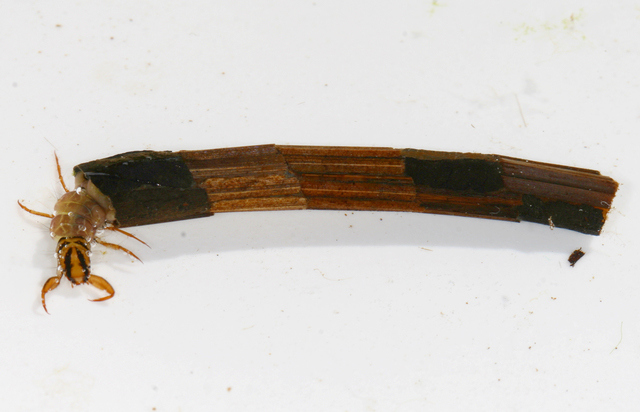
The Phryganeidae are a small family of caddisflies distributed throughout North America, Europe, and Asia. Wiggins (1996) lists the total as 15 genera and ~75 species; by my count from the World Trichoptera Checklist (Morse 2011) there are 80 extant and 37 fossil species. This family includes the largest known caddisflies. The larvae are case makers (as the common name suggests), and fashion tube cases of spiral or circular wrapped vegetation.
The genus name Phryganea has a long history of use, starting in the 10th edition of the Systema Naturae (Linnaeus 1758). Carl von Linne included 17 species of caddisflies in this work, all under the genus Phryganea (from the French word for caddisflies). Needless to say, most of these species have been removed to other families and genera. At the time, caddisflies, stoneflies, dragonflies and mayflies were all included under the order Neuroptera; it wasn't until 1813 that the Order Trichoptera was erected. Due to the original status of the genus, there are many nomenes dubius and synonyms that by far outnumber the species now in the entire family.
 Banksiola dossuaria (© Trichoptera Barcode of Life)
In addition to large size (often greater than 25 mm), the adults are characterized by colorization ranging from the black and white checkers of Banksiola to the fall leaf orange of Ptilostomis to the yellow and dark purple of Eubasillissa. The largest species, Eubasillissa regina, is over 4 cm with an 7 to 8 cm wingspan. Dr. John Morse, who has spent much time collecting and studying aquatic insects in Southeast Asia, told me they look like a small bird with a strange flight pattern from afar.
 Eubasilissa regina, the worlds largest caddisfly.
The larvae often have contrasting patterns of orange and black stripes on head and thorax, and are just as impressive as the adults in size. One of the most curious larval tendencies is the ease at which they leave their cases behind when disturbed. If one larva looses it's case and other of a similar size is occupied nearby, the two larvae will fight over the case (as illustrated in this video). Though they inhabit a wide variety of aquatic habitats, they are found most often around the roots and stems of aquatic vegetation, and in root balls of woody plants, with a diet of mostly aquatic invertebrates.
The definitive guide for the family is an eponymously named book by Glen Wiggins (1998), and despite being over ten years old is still in print and in demand. The book includes genus keys and diagnoses for all the species know at its publication, including all 28 North American species. Wiggins splits the family into the Yphriinae (which includes a single species of Yphria from Western North America), and the Phryganeinae, though the separation is drawn due to 'primitive characters' possessed by Yphria is to me not particularly convincing, and may be paraphyletic.
References
Morse, J.C. (ed.) 2011. Trichoptera World Checklist. http://entweb.clemson.edu/database/trichopt/index.htm [Accessed 24 October 2011.]
The genus name Phryganea has a long history of use, starting in the 10th edition of the Systema Naturae (Linnaeus 1758). Carl von Linne included 17 species of caddisflies in this work, all under the genus Phryganea (from the French word for caddisflies). Needless to say, most of these species have been removed to other families and genera. At the time, caddisflies, stoneflies, dragonflies and mayflies were all included under the order Neuroptera; it wasn't until 1813 that the Order Trichoptera was erected. Due to the original status of the genus, there are many nomenes dubius and synonyms that by far outnumber the species now in the entire family.
Banksiola dossuaria (© Trichoptera Barcode of Life)In addition to large size (often greater than 25 mm), the adults are characterized by colorization ranging from the black and white checkers of Banksiola to the fall leaf orange of Ptilostomis to the yellow and dark purple of Eubasillissa. The largest species, Eubasillissa regina, is over 4 cm with an 7 to 8 cm wingspan. Dr. John Morse, who has spent much time collecting and studying aquatic insects in Southeast Asia, told me they look like a small bird with a strange flight pattern from afar.
Eubasilissa regina, the worlds largest caddisfly.The larvae often have contrasting patterns of orange and black stripes on head and thorax, and are just as impressive as the adults in size. One of the most curious larval tendencies is the ease at which they leave their cases behind when disturbed. If one larva looses it's case and other of a similar size is occupied nearby, the two larvae will fight over the case (as illustrated in this video). Though they inhabit a wide variety of aquatic habitats, they are found most often around the roots and stems of aquatic vegetation, and in root balls of woody plants, with a diet of mostly aquatic invertebrates.
The definitive guide for the family is an eponymously named book by Glen Wiggins (1998), and despite being over ten years old is still in print and in demand. The book includes genus keys and diagnoses for all the species know at its publication, including all 28 North American species. Wiggins splits the family into the Yphriinae (which includes a single species of Yphria from Western North America), and the Phryganeinae, though the separation is drawn due to 'primitive characters' possessed by Yphria is to me not particularly convincing, and may be paraphyletic.
References
Morse, J.C. (ed.) 2011. Trichoptera World Checklist. http://entweb.clemson.edu/database/trichopt/index.htm [Accessed 24 October 2011.]
Wiggins GB. 1977. Larvae of the North American Caddisfly Genera. University of Toronto Press, Toronto, ON.
Wiggins, G.B. 1998. The Caddisfly Family Phryganeidae (Trichoptera). University of Toronto Press, Toronto, ON.
Thursday, September 29, 2011
Possible new endangered listing for southeastern aquatic insects.
The Center for Biological Diversity and other environmental groups petitioned the US Fish and Wildlife Service last year to give 404 southeastern aquatic species federal endangered listing, and it looks like FWS will finally be addressing 374 of these:
Of the 9 species of caddisflies from the original 404 petition on the Center for Biological Diversity website, the below six are being considered (full list is here).
The list includes 44 other insects in addition to the caddisflies (though the silk moth and the butterflies are not /really/ aquatic, they have larvae feeding on plants which are often semi-aquatic). I do appreciate insect conservation minded people in an environmental movement which often focuses exclusively on megafauna.
Species announced today include 13 amphibians, six amphipods, 17 beetles, three birds, four butterflies, six caddisflies, 81 crayfish, 14 dragonflies, 43 fish, one springfly, two isopods, four mammals, one moth, 35 mussels, six non-vascular plants, 12 reptiles, 43 snails, eight stoneflies and 75 vascular plants, FWS said.
Of the 9 species of caddisflies from the original 404 petition on the Center for Biological Diversity website, the below six are being considered (full list is here).
- Hydroptila sykorai
- Agarodes logani
- Lepidostoma morsei
- Triaenodes tridontus
- Oecetis parva
- Oxyethira setosa
The list includes 44 other insects in addition to the caddisflies (though the silk moth and the butterflies are not /really/ aquatic, they have larvae feeding on plants which are often semi-aquatic). I do appreciate insect conservation minded people in an environmental movement which often focuses exclusively on megafauna.
Tuesday, July 5, 2011
When honomyny goes wrong.
Christopher Taylor (Catalogue of Organisms) just published this excellent post in reference to Dr. O'Hara's recent paper in Zootaxa on the CESA itch. The CESA itch (not to be confused with the mihi itch) is a particular recent condition of certain taxonomists who are inclined to scour online databases for potential homonyms and publish them en masse, regardless of what groups these researchers are actually competent in, and often without the basic research to do it properly. This malady is named after the Centre for Entomological Studies Ankara, where Drs. Kocak and Kemal enjoy combing the web for new homonyms and naming their replacements after CESA. Which wouldn't be that bad if the results weren't amateurish taxonomic hack jobs.
Since Mr. Taylor has covered CESA-itch in detail, I would just like to outline one particularly grievous example from Dr. O'Hara's paper. An example that is close to my heart since it involves Trichoptera AND Sciaroidea.
Allomyia is a perfectly valid genus of Trichoptera (Fam. Apataniidae) published by Nathan Banks in 1916. Two objective homonyms were published soon after, Allomyia Felt 1918 (a genus of cecidomyiid gnats) and Allomyia Malloch 1919 (a genus of scathophagid muscoid flies). It was later revealed that Allomyia Felt was a junior subjective synonym of Oligotrophus Latreille 1805, and Allomyia Malloch was replaced with Allomyella (by Malloch himself, in 1923), so neither of these are in conflict.
More recently, two more homonyms have been described separately, by Fedotova in 1991 and Ren in 1998. Both of these were still in conflict at the time of Kocak and Kemal's 2010 paper. They had coined Sauricesa as a replacement for Allomyia Fedotova 1991, unaware of the homonyms by Ren, Felt, and Malloch, and that Fedotova's name had already been replaced by Gagne in 2004. They were apparently even unaware that Fedotova was describing a genus of Cecidomyiidae, not Tabanidae.
Given their complete unawareness and ineptitude at primary research, Kocak and Kemal moved 20 species from Apataniidae, Cecidomyiidae, and Scathophagidae to Tabanidae, a collection of not just Diptera but also Trichoptera! Let me clarify: these authors moved species across orders of insects. They put caddisflies in with the horseflies. And they did so because they cared more about publishing papers than getting things right, about blindly surfing computer databases than researching primary literature. This could have been done right, easily.
As it stands, Allomyia Ren 1998 has not yet been replaced, but given the gross incompetence of people who blindly replace homonyms, I think that task is best left to an expert in tabanid flies.
Thursday, April 7, 2011
Molecular techniques and species discovery.
I received a link to this poll in my e-mail through the Entomological Collections Network listserv. While I appreciate being able to give my imput, most of the important questions, (e.g. "do you think molecular techniques help in species discovery" were yes/no questions with no space for comments. The most interesting of these was "Do you think molecular techniques can accelerate species description?" To which I answered no, emphatically.
Despite complaints to the contrary, species description is not a particularly difficult process. While Botanical and Zoological Nomenclature differ in that the botanical code requires the primary description to be written in Latin, they otherwise have all the same features. There is a brief introduction and materials and methods, followed by the diagnosis (short description meant to separate the new species from other known members of that group) and description (longer statement of all aspects of the morphology). Typically there are illustrations, which can be achieved with a microscope that has a grid eyepiece (or a camera, if you're lucky enough to work with larger organisms). Then the material examined, remarks on biology, systematics and distribution, and works cited. I have already discussed techniques to accelerate the activities that go into species description before the actual writing part. Notice that none of those include any molecular techniques.
The simple truth is, while molecular techniques may speed up the process of resolving cryptic species complexes, they seldom (if ever?) increase the speed at which species are described. Current estimates are that there are millions of undescribed species on Earth, most of those being arthropods. And I propose that many of these are sitting in museums and unsorted trap samples. The ICZN still requires a formal description for a name to be recognized, and without a name it's very difficult to talk about something. If you look at what characters people are using in their descriptions and diagnoses, 99% of the time these are gross morphology. And, for the vast majority of all the species yet to be described, this is all that is necessary. To make things easier, there are journals such as Zootaxa which specialize in publishing descriptions of new species, and have accelerated peer review and publication time within a month.
Accelerated species description will not occur when everyone has a lab equipped with a pyrosequencer. Accelerated species description will occur when biologists as morphologists spend more time contemplating Evenhuis' Steps to Enlightenment and Taxonomic Nirvanna. The only way species get described is by writing a paper, and the only way diagnoses and descriptions get written is by looking at the organisms. Collecting from poorly sampled regions, sorting old trap samples, building taxonomic libraries, photographing and illustrating type specimens, and many many hours at the microscope examining morphology, these are how species description will accelerate. Not by molecular techniques.
Subscribe to:
Posts (Atom)


